Hey there, bargain hunter.
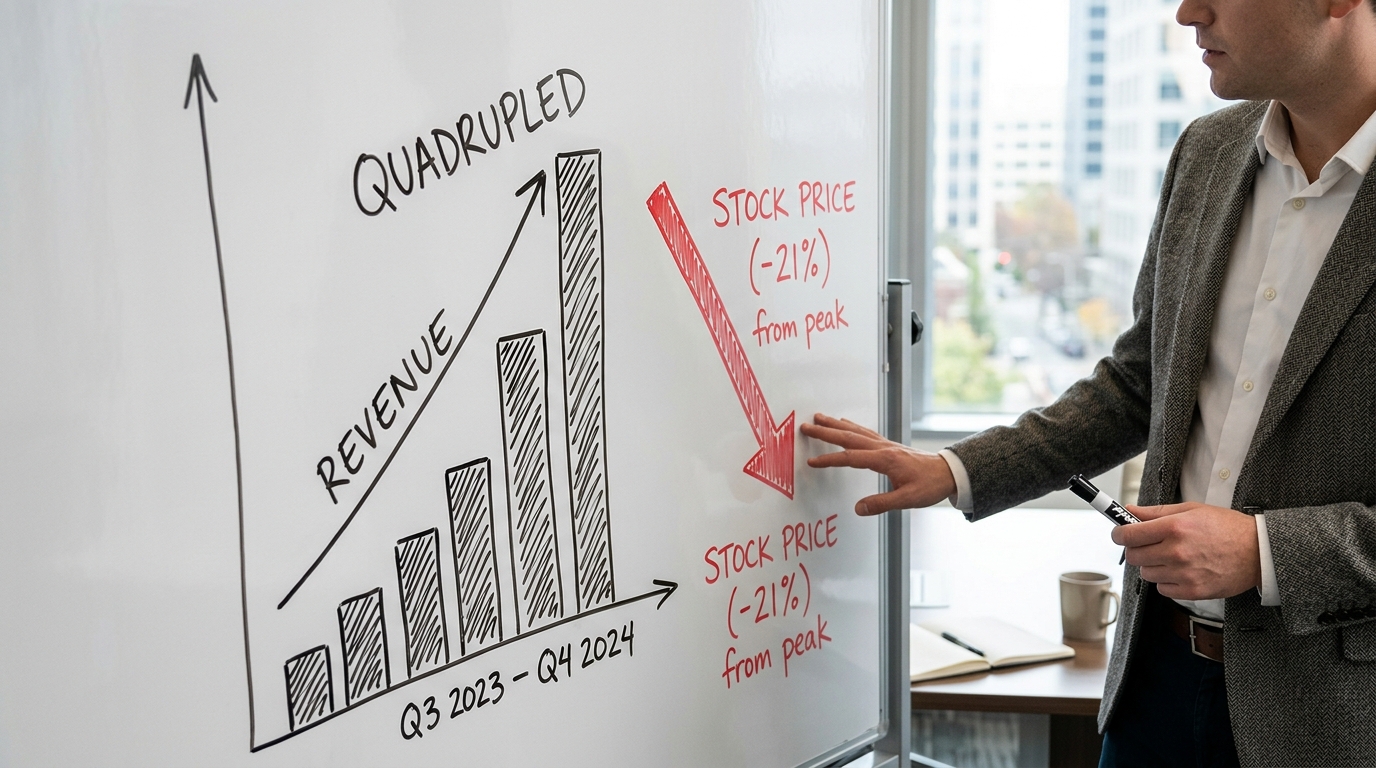
Here is something that does not happen often. A company reports the biggest quarter in its history. Revenue more than quadruples year-over-year. Earnings per share beat estimates by almost 24%. Guidance for the next quarter comes in at $50 billion, roughly 15% above what analysts were expecting. The stock pops about 15% after hours.
Then over the following weeks it gives back more than a fifth of its value and sits today around $983 per share, down roughly 21% from post-earnings highs.
That is Micron Technology right now.
What Actually Happened in Q3
Micron’s fiscal Q3 2026 results, reported June 24, were not incrementally good. They were historically good. Revenue hit $41.46 billion against a consensus estimate of about $35.25 billion. EPS landed at $25.11 versus an estimate of about $20.28, a beat of nearly 24%. A year earlier, the company earned $1.91 per share on $9.30 billion in revenue.
Data center revenue climbed more than sevenfold to $11.5 billion. Cloud memory was up over 300% to $13.77 billion. Mobile and client revenue grew about 254% to $11.52 billion. Automotive and embedded was up about 311% to $4.63 billion. Every segment. Every one.
Then guidance came out. Q4 revenue of $50 billion, plus or minus $1 billion. Gross margin of approximately 86%. Non-GAAP EPS of $31.00, plus or minus $1.00. Analysts had been looking for about $43.58 billion in revenue. The actual guidance was roughly $6 billion ahead of that.
And yet here we are, with MU sitting about 21% below its post-earnings peak and more than 20% below its 52-week high of $1,255.
Why the Pullback Happened
Three things are weighing on the stock. First, SK hynix listed on the Nasdaq on July 10, initially trading on a “when-issued” basis under SKHYV before transitioning to SKHY. SK hynix is Micron’s primary competitor in high-bandwidth memory and the listing gave U.S. investors a new direct way to play the same HBM demand wave. SK hynix rose about 13% on its debut. Some of that capital may have rotated out of MU.
Second, Michael Burry disclosed a short position in Micron. Burry’s short calls get attention regardless of the underlying thesis, and his positioning has been used as a sentiment anchor by bears who argue memory pricing is peaking and the cycle will turn.
Third, the stock ran from around $103 at its 52-week low to $1,255 at its high. A 700% gain in under a year creates a lot of holders with profits to protect, and any excuse to reduce exposure after a historic earnings beat is often taken.
The Business Case Is Unusually Clear
Micron is one of only three companies on earth that make high-bandwidth memory at scale. The other two are SK hynix and Samsung. HBM sits directly on Nvidia AI chips and is not easily substituted. Every Nvidia GPU order from a hyperscaler requires HBM to go with it.
Micron has said its calendar 2026 HBM volume and pricing negotiations are completed, and it has highlighted multi-year Strategic Customer Agreements (SCAs) that management says should increase revenue durability. On Micron’s fiscal Q3 2026 earnings call, the company said 14 of its 16 SCAs have approximately $100 billion of minimum contracted revenue at minimum price over the remaining agreement term. Micron also announced a strategic agreement with Anthropic that spans memory and storage AI architecture design, supply and demand planning, and includes a strategic investment in Anthropic’s Series H funding round.
Analyst consensus from 45 analysts is a Strong Buy, with an average 12-month price target of approximately $1,486, representing roughly 51% upside from current levels.
The Valuation Debate
Here is what makes this genuinely interesting for a cost-conscious investor. Despite the historic growth, Micron trades at roughly 7 times forward earnings. The S&P 500 averages around 21 times. For a company growing revenue at about 4.5 times year-over-year and guiding gross margins toward 86%, a sub-10x forward multiple is unusual.
The cyclical argument against that math is real. Memory markets have a history of boom and bust. Capacity expansion by all three suppliers could eventually catch up to demand, pressuring prices. Samsung’s recent quarterly results spooked the sector briefly, raising questions about whether pricing has peaked in some memory categories.
But Micron’s multi-year agreements are a different structure than the spot-market exposure that drove past cycles. Revenue predictability looks more like a software business than a chip commodity trader.
Bull, Base, Bear
- Bull: HBM4 ramps ahead of schedule, Q4 revenue hits $50 billion or above, gross margins hold near 86%, AI capex from hyperscalers continues at the reported $725 billion pace. MU closes the gap to analyst targets near $1,486.
- Base: Q4 delivers as guided. Stock gradually recovers toward $1,100 to $1,200 as memory cycle fears fade and the SK hynix overhang clears.
- Bear: Samsung increases HBM output faster than expected, pricing pressure emerges in spot DRAM, and the cyclical bears are proven right. A pullback toward $700 to $800 is possible if the macro turns or hyperscaler capex pauses.
What to Watch Next
The next hard catalyst is Micron’s fiscal Q4 earnings, expected around September 22, 2026. Between now and then, the key signals are HBM supply commentary from Nvidia, AMD, and the hyperscalers on their own earnings calls, and any pricing data from the DRAM spot market.
The stock is down from its peak on competitive noise and profit-taking. The business, by any metric available, is performing at levels it has never seen before. That gap between price action and fundamentals is either a trap or an opportunity. The question every bargain hunter has to answer is whether you believe the contracts are durable or the cycle is about to turn. Right now, the contracts say one thing and the shorts say another. September will have a lot to say about who is right.