It started in Qatar. Not with a regulation, not with a trade war, not with a geopolitical press release. Just a missile strike.
The semiconductor supply chain disruption of 2026 didn’t start inside a chip factory. It started in the Gulf, when strikes hit Ras Laffan Industrial City in Qatar, one of the largest liquefied natural gas and helium production hubs on the planet. Within days, Samsung and SK Hynix were on high alert. Helium shipments through the Strait of Hormuz had come to a standstill.
That single event exposed something most of Wall Street had simply never thought to look at: the AI industry runs on a gas that barely costs $10 per wafer to use, but whose absence can shut an entire fab down.
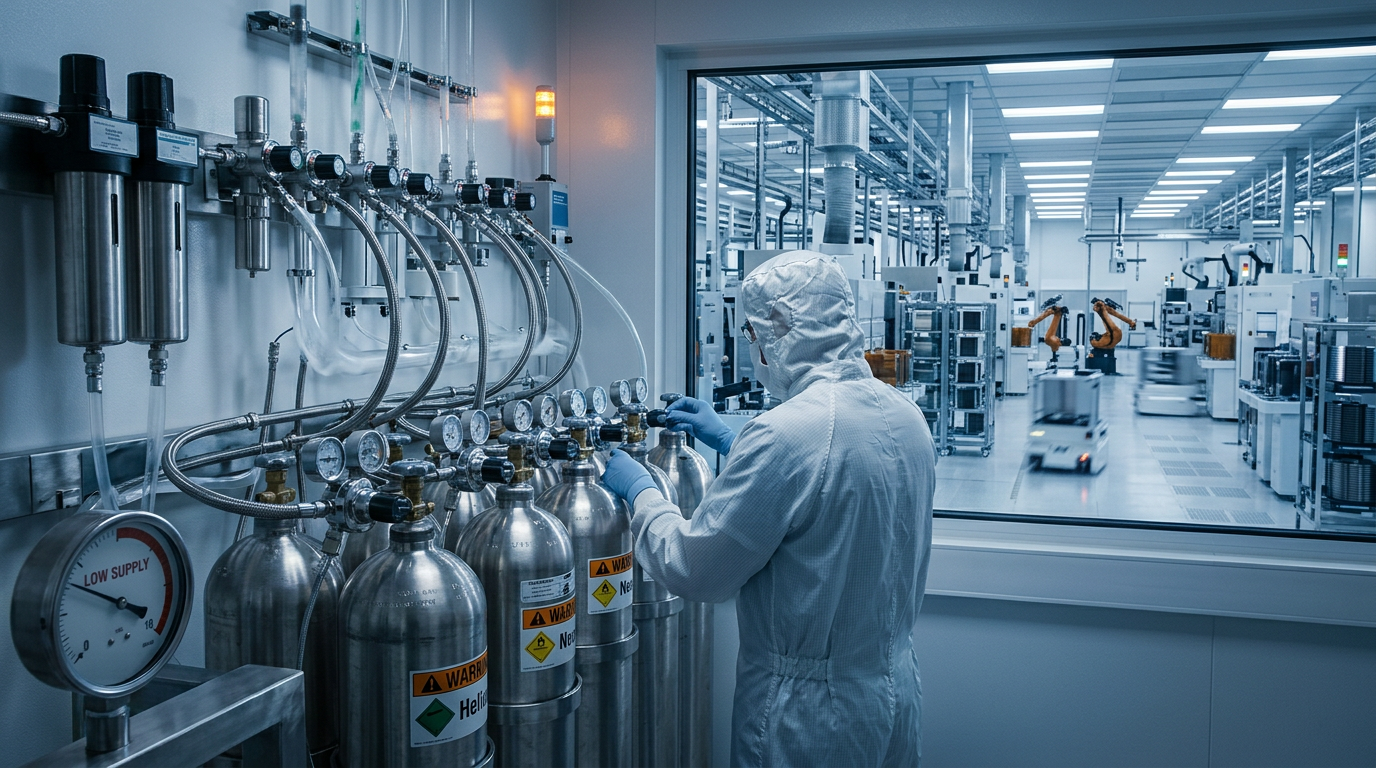
Helium plays a critical role in producing advanced chips. It’s used in extreme ultraviolet lithography systems that manufacture the chips powering AI infrastructure. And helium is difficult to replace.
Difficult to replace isn’t a throwaway phrase here. Helium has to be stored at extremely low temperatures and shipped in specialized containers that can cost up to $1 million each and take up to 18 months to produce. That lead time problem doesn’t resolve itself in a quarter. It doesn’t resolve with a tariff exemption. And no analyst at a major bank is modeling this as a primary AI risk — at least not yet.
What’s Actually Happening in the Fabs
The reality of 2026 is defined by a brutal shortage of electricity, copper, and critical gases. The headlines have focused mostly on power and copper. But the gas story is quieter and, in some ways, more structurally interesting.
Nitrogen is used throughout chip manufacturing, for purging, blanketing, controlled atmospheres, wafer transport, and as a carrier gas in deposition processes. Critically, AI chips are increasing nitrogen consumption per wafer, not decreasing it. As TSMC, Samsung, and Intel push to 3nm and 2nm nodes, with advanced packaging like CoWoS and chiplet integration, each wafer requires more process steps, longer purge cycles, and higher-purity atmospheres.
Then layer helium on top of that. Fabs in Taiwan and South Korea are now rationing helium. This net supply shortage could lead to a potential reduction in chip production.
And here’s the part that makes this more than a geopolitical one-off: these are incremental improvements at best. Nobody’s found a way to cut helium use in half.
Slight tangent, but it matters: global helium production is dominated by the U.S. at 42.6% and Qatar at 33.2%. South Korea imports 64.7% of its industrial helium from Qatar, all of which must transit the Strait of Hormuz. That’s not a supply chain risk. That’s a single-point dependency. And it’s baked into the foundries producing the chips Wall Street has priced at a $1 trillion-plus trajectory.
The Company That Sells Every Fab the Same Thing Every Day
Here’s where the second-order effect shows up.
When a hyperscaler commits $100 billion to AI infrastructure, analysts model GPU orders. They model power contracts. They model construction timelines. They do not model who fills the tanks at the fab every morning.
Air Products and Chemicals (APD) and Linde PLC (LIN) control the majority of the global industrial helium supply and distribution network, giving them absolute pricing power over semiconductor customers.
Absolute pricing power. Not moderate. Not improving. Absolute.
Analysts predict that U.S. industrial gas suppliers such as Air Products, Linde, and ExxonMobil could see increased demand and greater pricing power as global supply tightens and customers shift toward more reliable U.S. and North American sources. JPMorgan and Wells Fargo recently upgraded Air Products and Linde, citing the tightening helium market and expected price recovery as a positive.
Linde is the more interesting name here. It’s larger, more profitable, and more structurally embedded at the point of production. From an AI lens, Linde’s business intersects with artificial intelligence at three distinct levels. First, as a direct input supplier to semiconductor manufacturing, Linde supplies ultra-high-purity nitrogen, oxygen, argon, hydrogen, and specialty gases to chipmakers including TSMC, Samsung, and Intel. AI chip complexity at 3nm and 2nm node transitions, chiplet packaging, is increasing gas consumption per wafer, not reducing it.
This is worth sitting with. As AI chips get more complex, they consume more gas per unit, not less. That’s not a commodity story. That’s a structural volume and pricing story unfolding in slow motion.
The Moat That Can’t Be Replicated Overnight
What makes this particularly interesting is that Linde’s competitive position isn’t just about ownership of gas supply. It’s physical.
Because industrial gases are heavy and expensive to transport, Linde has geographic moats around each of its production hubs. A competitor can’t just roll into Arizona and undercut Linde’s local pipeline network. Too hard, too costly, and simply too late.
These contracts often span 10 to 20 years for large on-site plants connected by pipelines, which gives Linde predictable cash flows and supports its dividend and share buyback strategy over time.
So the revenue isn’t speculative. It’s contractual. Multi-decade. And the new fabs being built right now are locking in that revenue for the next generation of AI infrastructure.
Intel, TSMC, and Samsung are all building new semiconductor fabs in Arizona and Texas today. We’re talking billions of dollars of construction, all requiring Linde’s gases every single day for decades. This is recurring revenue locked in by long-term contracts.
The clean energy backlog adds another layer. The clean energy project backlog sits at $10 billion. Despite Washington battles, clean projects are still happening and they require Linde’s specialty gases. Management expects $2.5 to $3 billion of these projects to start generating revenue in 2026 alone.
What the Numbers Say Right Now
This isn’t a future story. The signal is already in the financials.
Air Products reported better-than-expected Q1 2026 results on April 30, raising its full-year adjusted earnings per share guidance to $13.00–$13.25. The company explicitly cited helium price strength as a direct tailwind and has activated domestic U.S. storage facilities and boosted liquefaction capacity.
Linde, meanwhile: LIN reached its all-time high on July 7, 2026, with a price of $548.20. The stock has been quietly moving while most investors are debating which hyperscaler to own. Linde’s 2026 guidance reflects 6% to 9% EPS growth.
The company enters 2026 with the industry’s best EBITDA margins, exceeding 28%, and a dominant 32% global market share.
That combination — pricing power, contractual moats, expanding volume, and margin leadership — is what a lot of investors say they’re looking for in an AI infrastructure play. They just haven’t thought to look here.
Why Wall Street Is Still Slow to Price This
The honest answer is that industrial gases don’t trend on social media. You can’t demo a nitrogen molecule at a conference. There’s no product launch. No earnings guidance headline screaming “AI tailwind.”
The gas just gets delivered. The fab runs. The chip ships. The investor model credits the chipmaker and the hyperscaler and never asks who filled the tank.
Nitrogen has gone from a sleepy industrial commodity to a structural beneficiary of the largest CapEx cycle in modern industrial history. Global AI capital expenditure is on track to grow from roughly $360 billion in 2025 to about $480 billion in 2026, and almost every dollar of that translates into incremental nitrogen demand somewhere along the chain.
The supply side, meanwhile, is constrained by long lead times, power-intensive economics, and a producer market dominated by four companies that are now openly prioritizing their largest accounts.
Four companies. Dominated market. Growing volume. Locked-in contracts. Absolute pricing power in a helium shortage.
That’s not a setup Wall Street has fully priced. And the fab buildout has decades to run.
For informational purposes only.