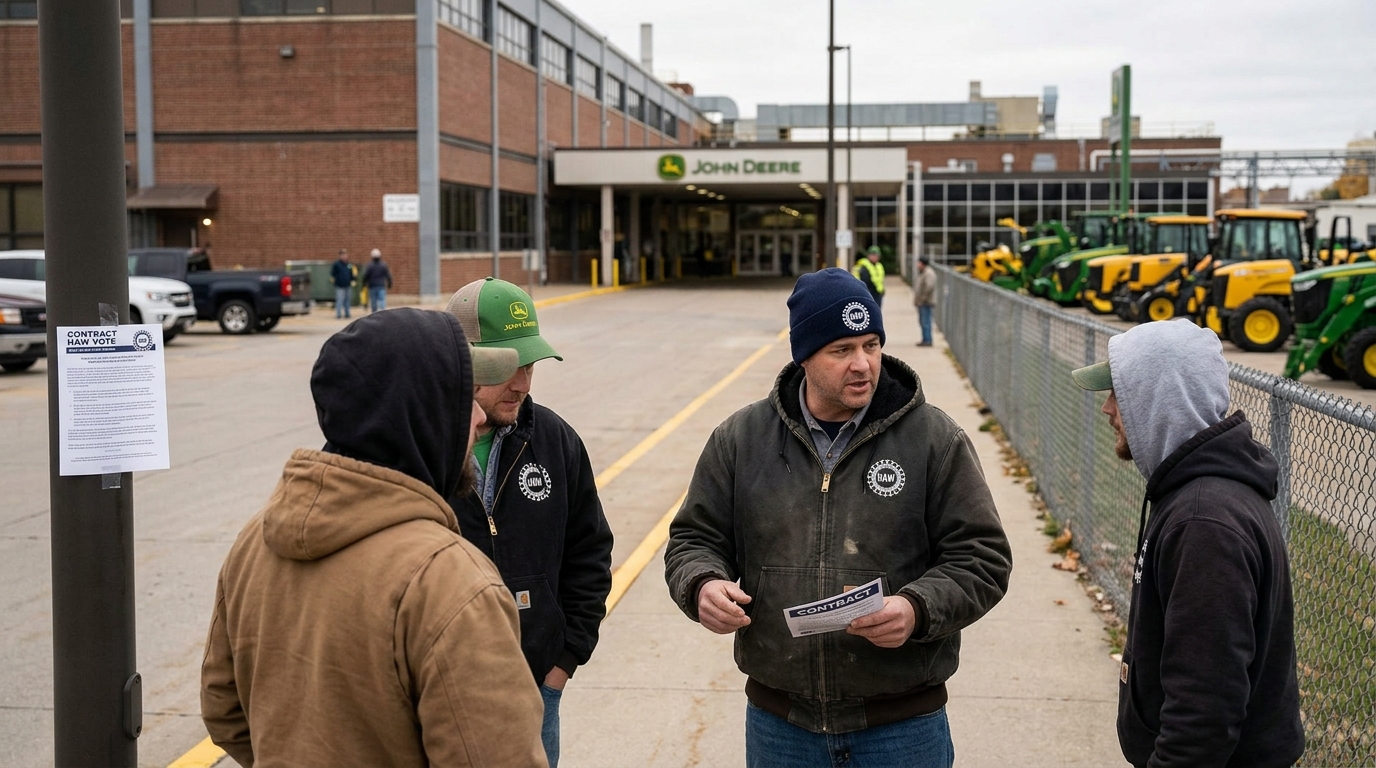
Sunday’s vote was quiet news by the standards of a strike authorization. No work stoppage, no immediate disruption. UAW members voted to reject Deere’s proposal to extend the current collective bargaining agreement, which runs through October 2027, out to October 2029. The agreement covers about 10,000 workers across multiple Deere facilities in Iowa, Illinois, and Kansas. Full negotiations now open next year.
What Deere lost is less dramatic than a strike and more consequential than it appears. The extension was priced at 4% wage increases effective Nov. 1, 2026 and Nov. 1, 2027, plus a $3,000 ratification bonus. That is a known, budgeted cost. What replaces it is an open negotiation conducted in 2027, at the moment when Deere’s management believes the agricultural equipment cycle will be recovering. Deere’s Q3 results, reported August 20, put fiscal 2026 net income guidance at $4.75 billion to $5 billion, with management calling 2026 the bottom of the ag equipment cycle. A 2027 negotiation happens precisely when volumes may be turning up and revenue visibility improving, conditions that historically empower unions to seek more aggressive terms.
UAW President Shawn Fain made the financial case explicit. The union criticized Deere’s shareholder payouts and executive pay in arguing against the extension. The committee has no opinion on the merits of that argument, but it does have an opinion on what it means for modeling.
The 2021 contract, ratified after a strike that lasted a little more than five weeks, locked in terms at a moment when Deere had significant negotiating leverage. The extension Deere proposed would have carried those 2021-era terms forward to 2029, a structurally favorable outcome for a company whose Production and Precision Agriculture segment is already seeing sales decline 6% year-over-year. The rejection means that favorable labor cost structure expires in October 2027. An investor modeling Deere’s terminal margins through 2030 needs to assign a wider range of outcomes to the labor cost line starting in 2028.
The cycle context compounds the risk, not eliminates it. Deere’s Q3 materials kept its industry outlook for fiscal 2026 calling for U.S. and Canada large ag equipment sales down 15% to 20%, and South America down 15% to 20%. If 2026 is genuinely the trough and recovery unfolds gradually through 2027, Deere enters bargaining with improving revenue but a union holding data on recent peak profitability. That combination has historically produced larger wage settlements than management models anticipate.
AGCO and CNH face the same cycle dynamics without the same union concentration risk, a distinction worth carrying into relative valuation. The committee does not view this development as a reason to exit Deere, whose Q3 results demonstrated genuine earnings resilience. It is, however, a reason to widen the margin of safety applied to long-run earnings estimates and to resist assigning peak-cycle multiples to a business whose labor cost structure will be renegotiated precisely when the cycle peaks.