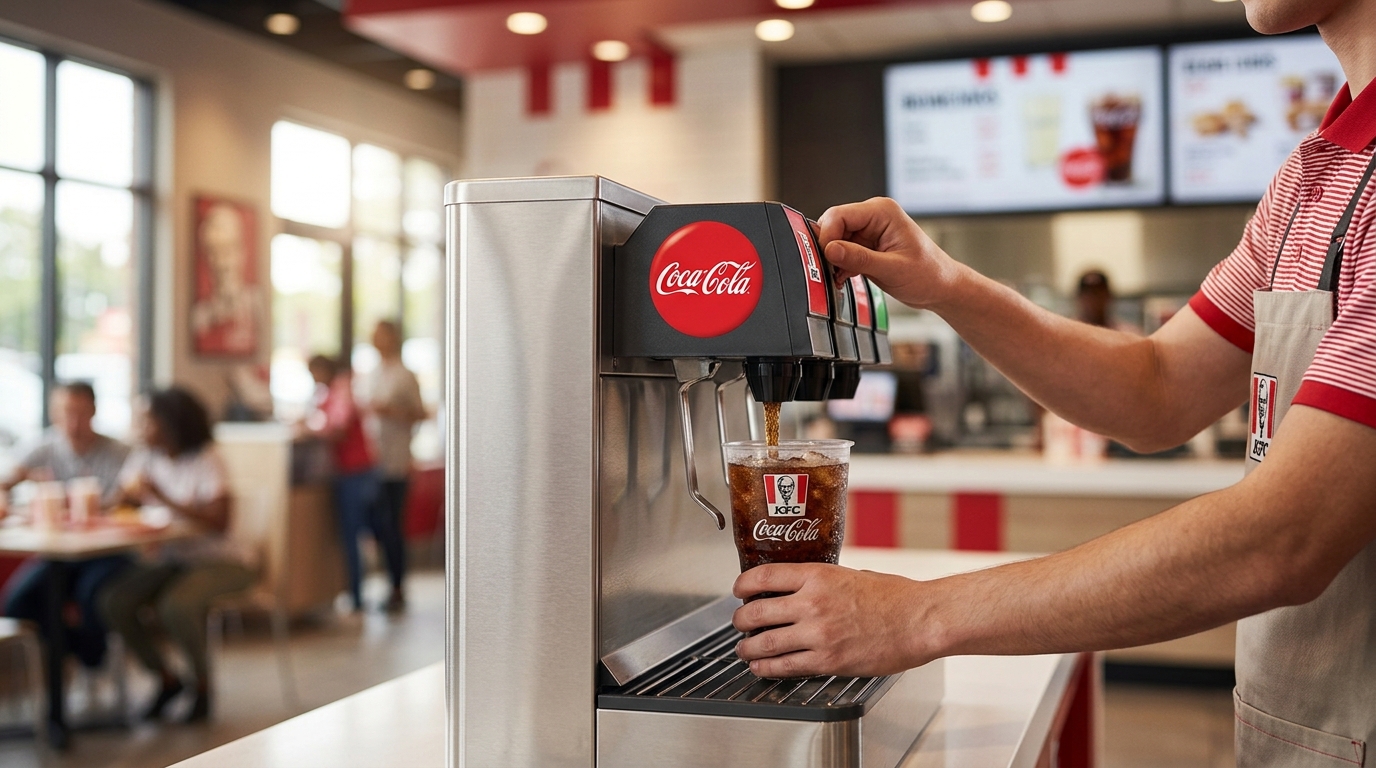
Before PepsiCo bought KFC in 1986, the fried chicken chain was Coca-Cola’s second-largest fountain account in the United States, trailing only McDonald’s. At the time of the acquisition, KFC was Coke’s second-largest fountain account, behind only McDonald’s. Pepsi flipped the fountain soon after ownership, and Coke lost the account for four decades.
On October 15, Coca-Cola got it back.
KFC’s U.S. restaurants will ditch PepsiCo and switch to Coca-Cola beverages starting in 2027, marking the first time in decades that the Yum Brands chain has changed its drink supplier. Coca-Cola products will begin rolling out at KFC restaurants in January 2027, with the transition expected to finish by spring 2027. That covers roughly 3,700 U.S. restaurants, a meaningful footprint for any beverage company hunting fountain volume.
KFC’s explanation centered on its turnaround effort. KFC U.S. President Catherine Tan-Gillespie described the decision as a critical step in the Kentucky Fried Comeback, adding that a new beverage partner gives the chain a platform to innovate, meet changing tastes and give customers more reasons to choose it. That framing belongs to KFC’s story. The more interesting story belongs to Coca-Cola’s.
A Pattern That Compounds
KFC did not arrive in isolation. For PepsiCo, losing KFC U.S. adds to recent account losses, including Marriott hotels, an account Pepsi held for 34 years, and Costco’s food court, which sold Pepsi products for roughly a decade. On July 1, Marriott International and Coca-Cola began rolling out a global agreement making Coke the beverage partner across more than 10,000 properties in about 146 countries. Before that, Panda Express moved from Pepsi to Coke in 2018, Arby’s did the same that year, and Costco moved its food courts back to Coke in 2025 after about twelve years with Pepsi.
This is not a single quarter’s momentum. It is the visible surface of a competitive advantage that has been accumulating for years: brand desirability at the operator level. Restaurant and hospitality chains do not switch beverage suppliers casually. The logistics cost is real. The customer habit disruption is real. When they switch anyway, it signals something about which brand has more pull with the consumer sitting across the table.
Evercore ISI analyst Robert Ottenstein estimated PepsiCo’s lost revenue at about $50 million a year, implying KFC sells roughly $350 million to $400 million of drinks at retail. Fifty million dollars is a rounding error on PepsiCo’s income statement. He argued the loss matters more than its size, because fast-food chains lean on beverages to drive traffic in a way hotels do not. The financial hit is modest. The signal about brand equity is not.
What the Mogul Sees Here
A long-term investor studying Coca-Cola today is not looking at a growth stock. Coca-Cola’s forward multiple reflects a business the market already respects deeply. The company expects to deliver organic revenue growth of 4% to 5% for full year 2026. That is not a number that gets investors out of bed in the morning. What deserves attention is the durability of how that growth is defended.
Fountain and foodservice contracts represent something rare: a recurring, sticky, high-visibility distribution channel that competitors cannot easily replicate. Winning McDonald’s in the 1950s and holding it for seventy years. Adding KFC in 2027 after a forty-year absence. These are not marketing victories. They are compounding proof that the brand carries weight with the people who buy beverages by the truckload.
PepsiCo still holds Taco Bell, a growing Yum Brands asset, and its snacks business gives it a portfolio dimension Coke does not match. Neither company is a simple trade. But the direction of the away-from-home account flow deserves to be read plainly: the big away-from-home accounts have been sliding in one direction for most of a decade. Competitive moats are not announced. They are revealed, one account at a time, over years. Coca-Cola just provided another data point.