The question institutional investors should be asking this morning is not what went wrong at NextDC. The question is whether the risk that destroyed about A$2 billion of market value overnight was ever priced into the sector at all.
NextDC cut its fiscal 2027 net revenue guidance to between A$475 million and A$500 million, from a prior range of A$615 million to A$640 million, while slashing underlying EBITDA guidance to A$245 million to A$265 million from A$385 million to A$410 million. Shares fell about 42% in Sydney, cutting its value to about A$4 billion.
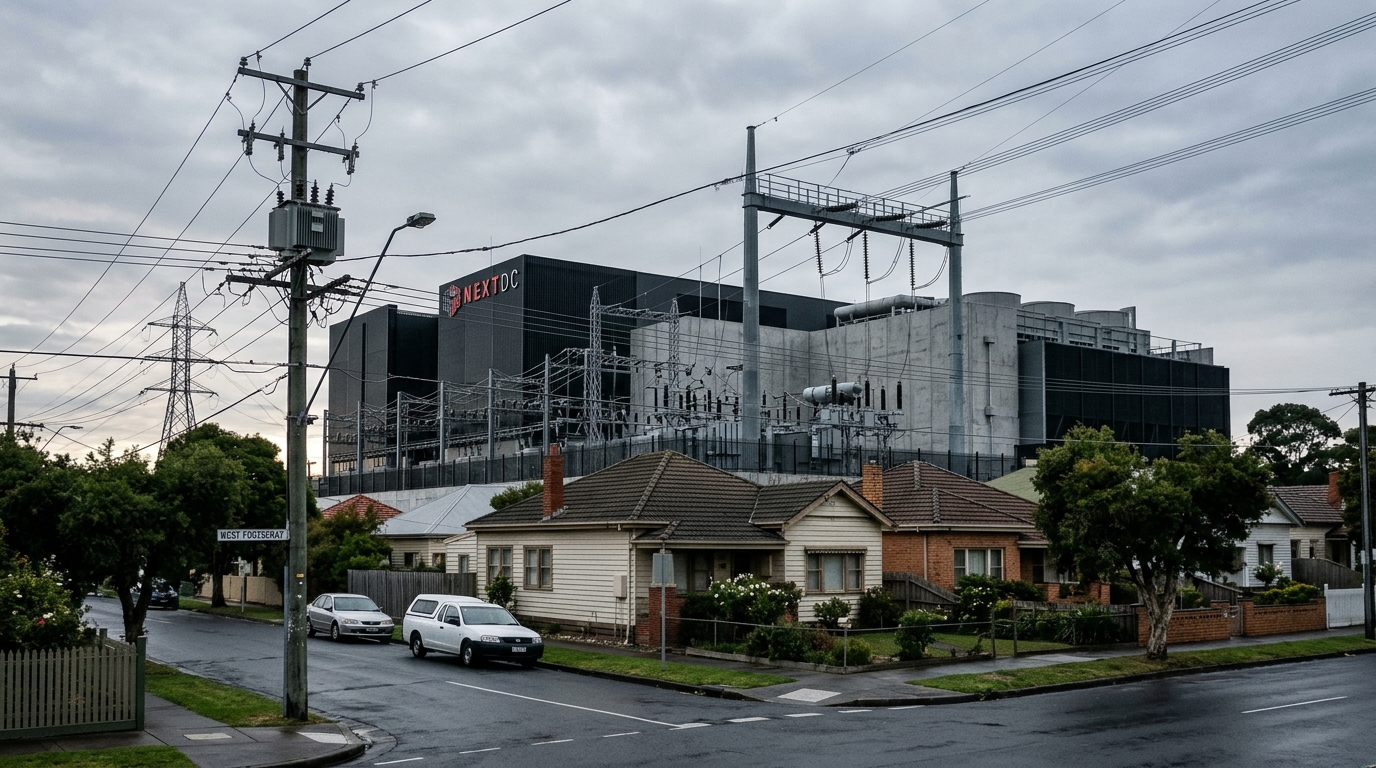
The trigger was not a contract loss, a technology shift, or a competitor. NextDC attributed the revised estimates to delays to electricity network upgrades by electricity distributor Jemena, required to increase power supply to its M3 data centre in West Footscray, a facility located about 15 metres from homes and long subject to community opposition. Community opposition centred on plans to install 15-metre concrete electricity poles in Melbourne’s West Footscray and Yarraville suburbs. Residents pushed back. Jemena paused the pole works.
The pause at the M3 site means Jemena does not expect to resume the pole upgrade works before February 2027. Jemena has said it paused the program while it takes time to better understand community feedback.
Citi said the earnings impact could extend beyond 2027 due to delays in expansion approvals and transformer upgrades. Installation of new transformers at the Brooklyn Terminal Station will also take longer than expected, and NextDC has said the Victorian government has not yet made a decision on a planning permit application lodged in February 2026 for M3 Stages 6 and 7. This is not one problem. It is three overlapping ones, none of them recoverable on a short timeline.
NextDC has put new development projects and land acquisitions on hold while reviewing spending priorities, with the board expected to announce the outcome at its annual general meeting on November 20, 2026. To conserve cash, NextDC plans to reduce capital expenditure for 2026/27 by A$750 million, to between A$4.5 billion and A$5 billion.
The investment committee debate worth having is about how broadly this risk spreads. NextDC is not alone. In September 2026, Goodman Group abandoned plans for a A$1.2 billion Sydney data centre following opposition from residents and policymakers. RBC Capital Markets analyst Tom Beadle said that while the delays to power supply and development approvals were out of NextDC’s control, it showed that community concerns around data centre developments present a real risk to the timing of contracted capacity for data centre owners. That framing is important: this is a category risk, not a company-specific failure.
Goodman Group, whose data centre pipeline now dominates its development work in progress, is worth watching here. Goodman has argued that securing power, land and capital in metropolitan markets where grid access and planning approvals are increasingly constrained is a competitive edge, and that construction-ready powered sites take years to assemble. That is a genuine competitive edge if it holds. But today’s events in Melbourne clarify that secured power is not the same as delivered power.
Stocks to Watch
- NextDC (ASX: NXT). The immediate question is whether the board review due November 20 produces a credible plan or signals further asset sales. NextDC has also said it is evaluating whether force majeure clauses may be invoked under relevant contracts. Both answers matter to the longer-term earnings base.
- Goodman Group (ASX: GMG). The Goodman Sydney abandonment last month and today’s NextDC collapse should together sharpen attention on how Goodman’s own projects navigate community and council approval across its metropolitan markets. Securityholders have already signalled growing interest in how the group manages data centre risks near sensitive areas.
- Jemena and regulated grid operators (unlisted, but relevant as counterparty risk). The Australian Energy Regulator set Jemena Electricity Networks’ allowed revenues for the 2026-31 regulatory period in April 2026, underscoring that spending and cost recovery for network upgrades sits inside a contested regulatory framework. That funding and regulatory uncertainty sits beneath every metropolitan data centre timeline in Australia.