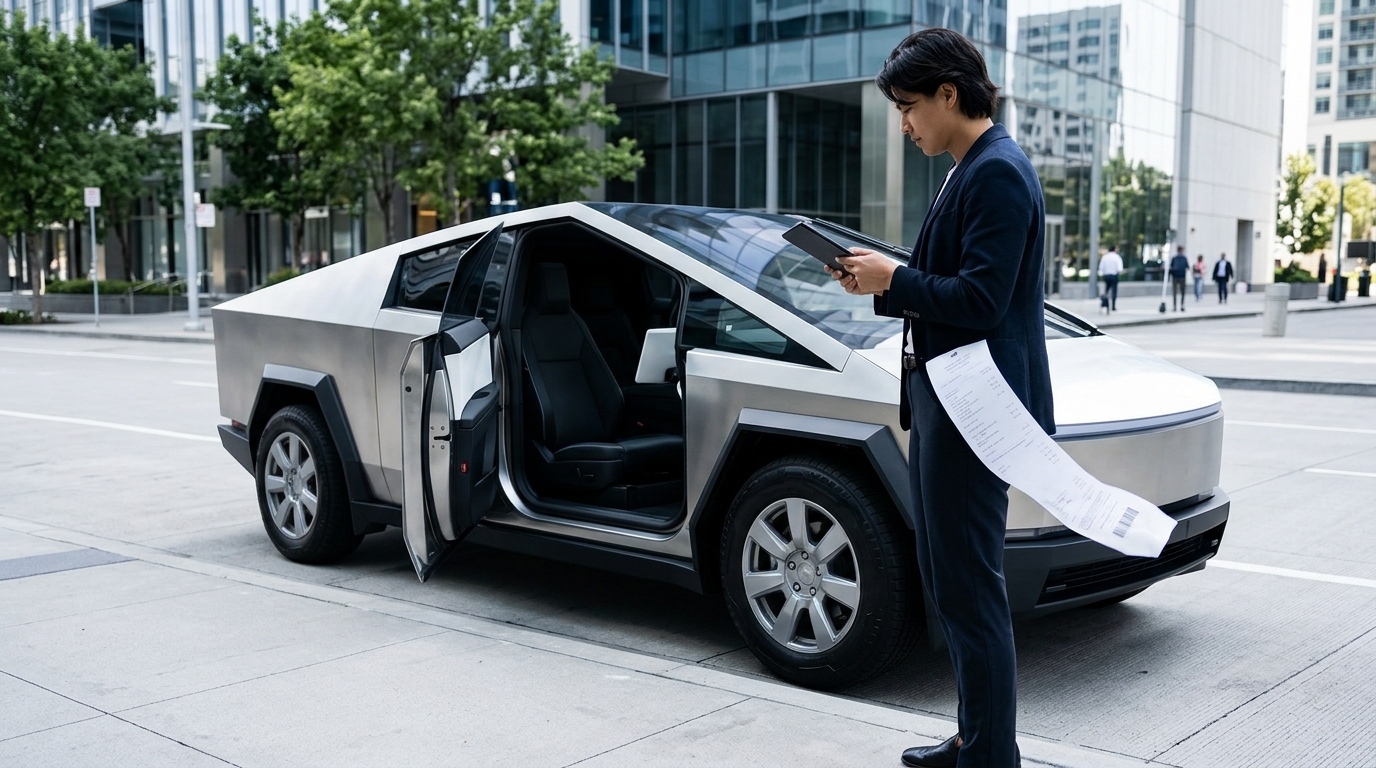
Tesla has never sold a car quite like this. Select customers are now being invited to buy a Cybercab for personal use at $29,990, but the car will not operate unless they also pay $299 a month for an “Autonomy Subscription.” There is no workaround: the Cybercab has no steering wheel or pedals and is designed to be fully autonomous, and Tesla’s own subscription terms say the vehicle “will not operate” without an active subscription. That is not a quirk of the offer. It is the entire business model.
The math is worth pausing on. At $299 per month, the subscription adds $3,588 a year to the cost of ownership after the introductory period, on top of the vehicle’s purchase price. Over four years, a buyer pays roughly $14,352 in subscription fees alone on a $30,000 car. The vehicle is the hardware. The subscription is the product Tesla actually sells you, indefinitely.
That is significantly higher than the $99 per month Tesla owners currently pay for the Full Self-Driving (Supervised) subscription, and it has already drawn pushback from the one person who could fix it. Musk posted on X that the $299 monthly fee “is too high” and suggested it should sit closer to what Tesla charges for Full Self-Driving (Supervised) plus Premium Connectivity for other models, roughly $115 a month. Whether that figure drops before December deliveries begin is the first thing to watch.
The Cybercab for personal use is currently restricted to operating within Tesla’s Robotaxi service areas, which Tesla says today are limited areas across multiple cities in Texas and Florida, including Austin, Dallas, Fort Worth and Houston, plus Miami, Orlando and Tampa. That is cheaper than many expected, but the subscription price can change, and Tesla’s Autonomy Subscription terms say customers will get one month’s notice before a price change. Buyers in Austin are essentially paying for a promise as much as a product.
Killing the Cybertruck Sends the Real Signal
The Cybercab order announcement arrived one week after a more consequential disclosure. Reuters reported on November 6, 2026 that Elon Musk said Tesla would wind down production of its stainless-steel Cybertruck at its Texas factory by mid-2027, framing the move as making room for increased Cybercab production.
The official reason does not hold up well under scrutiny. Reuters characterized the decision as coming after years of persistently weak Cybertruck sales. Cox Automotive estimated 20,237 Cybertrucks were sold in the U.S. in 2025, against Musk’s original target of 250,000 annually. It is also not accurate to say Tesla ended the Model S and Model X “this year” in the same sense as the Cybertruck decision: Tesla began sunsetting the Model S and Model X in mid-2026, and Tesla has said it decommissioned the Fremont manufacturing lines for those models to install first-generation Optimus production lines.
What matters for investors is what it reveals about conviction. Tesla is not hedging. It is converting manufacturing capacity, one vehicle at a time, into a bet that autonomous miles, not cars, become the core of its business.
Bull Case, Bear Case
This push toward low-cost, software-heavy robotaxi miles strengthens Tesla’s effort to build recurring service revenue on top of its existing EV base. If the Autonomy Subscription scales to hundreds of thousands of vehicles, the revenue profile starts to resemble a software company more than an automaker. That is a very different valuation conversation.
The bear case is geographic confinement and price sensitivity. A car that only operates inside specific service areas is not yet a mass-market product. At $299 a month, the total cost of ownership over three years rivals a leased luxury sedan. And Waymo, which has logged far more commercial autonomous miles, is not waiting for Tesla to find its footing.
What to Watch
Three things will determine whether this week’s announcements matter six months from now: whether Musk actually lowers the subscription price before broad delivery, how quickly Tesla expands the service areas, and whether the Gigafactory Texas line can build Cybercabs at a scale that justifies winding down the Cybertruck. Musk has said Tesla expects to ultimately build “several times more” Cybercabs per year than all its other vehicles combined. The gap between that claim and the current reality is where the investment thesis lives.
TSLA closed at $390.22 on November 13, 2026, down roughly 13% year-to-date. The stock has priced in a great deal of autonomous optimism already. This week gave investors something more concrete to test it against.