Hey there, bargain hunter.
Here is a number worth sitting with: $700 billion.
That is roughly what the four largest hyperscalers – Microsoft, Amazon, Alphabet, and Meta – are on track to collectively spend on AI infrastructure in 2026 alone. Not over a decade. This year. That figure represents a roughly 77% jump over their combined 2025 spending and is, without modern precedent, the largest private technology investment cycle in history.
Now here is the part the market has been slow to price.
The cash is running out.
What the Free Cash Flow Numbers Actually Say
Epoch AI parsed the SEC filings of the five largest cloud companies and found capex growing 70% a year against cash flow growing 23%. Across the group, free cash flow hits zero around the third quarter of 2026. That is not a forecast. It is an accounting identity already in motion.
Amazon is the clearest example. In the first quarter of 2026, it generated $26.0 billion in operating cash flow and spent $44.2 billion on capex. Its long-term debt has climbed past $119 billion. The company that built its reputation on running lean is now financing its future on credit.
Microsoft is not much different. Capital spending hit $38 billion last quarter alone. Free cash flow fell 10%, leaving less money available for stock buybacks and dividends. The stock is down more than 24% year-to-date – its worst annual start since the dot-com era collapsed tech valuations in the early 2000s.
Slight tangent, but it matters: this is not a Microsoft story. The four hyperscalers are on track to spend roughly 90% of their operating cash flow on capex this year, up from about 65% in 2025. That leaves almost nothing for buybacks, dividends, acquisitions, or a margin of safety.
What the Market Is Missing
Most of the coverage frames this as a binary: either AI spending pays off and the stocks recover, or it doesn’t and the whole sector corrects. That framing skips the more interesting third option.
The spending has to go somewhere. And the companies absorbing it are not the hyperscalers themselves.
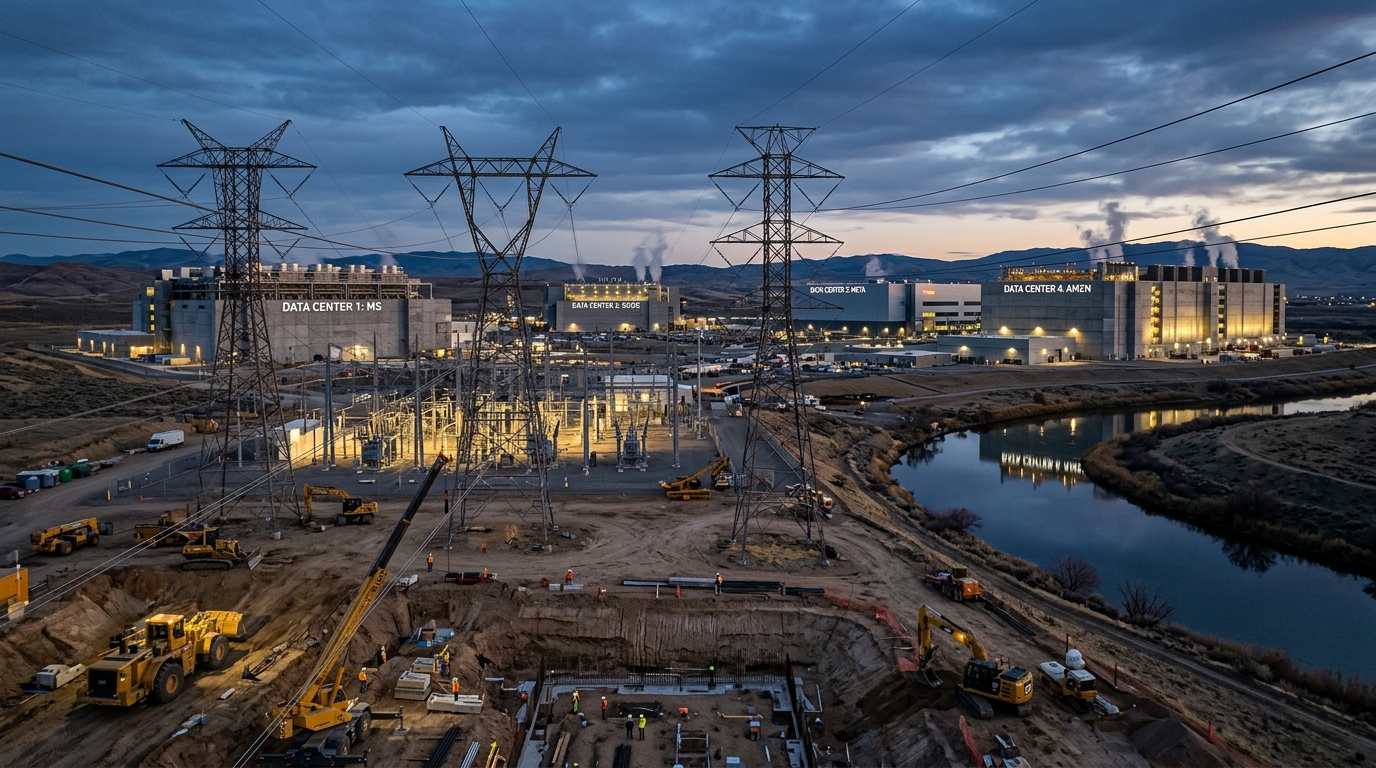
Power, cooling, and interconnect are now the bottleneck the $700 billion is trying to break. Data center operators, power infrastructure companies, and cooling technology providers sit at the intersection of all of it. Equinix reported roughly 60% of its largest Q4 deals were AI-driven, guided 2026 revenue to between $10.12 billion and $10.22 billion, and is up 42.91% year to date.
That is the trade most people are not running. The infrastructure layer – not the chip layer, not the hyperscaler layer – is where the capex actually lands.
The Valuation Reset
Here is where it gets interesting for patient buyers.
Azure is still growing. Azure posted a 31% year-over-year revenue increase in the most recent quarter. More than 80% of Fortune 500 companies are now using Microsoft’s AI offerings. The business is not broken. The stock is pricing in a scenario where the spending never converts. That may be right. It may also be the kind of fear-driven valuation that looks obvious in hindsight.
Bulls will note the P/E is near decade lows. Bears will point out that enterprise AI adoption is broad – 80% to 90% of firms using AI in at least one function – but shallow, with fewer than 40% of companies having scaled AI beyond pilot programs. The monetization clock is still running.
The real question is not whether AI infrastructure is being overbuilt. Some of it probably is. The question is whether you own the right layer of it.
The free cash flow math resolves one way or another in the next two quarters. That is the number worth watching.