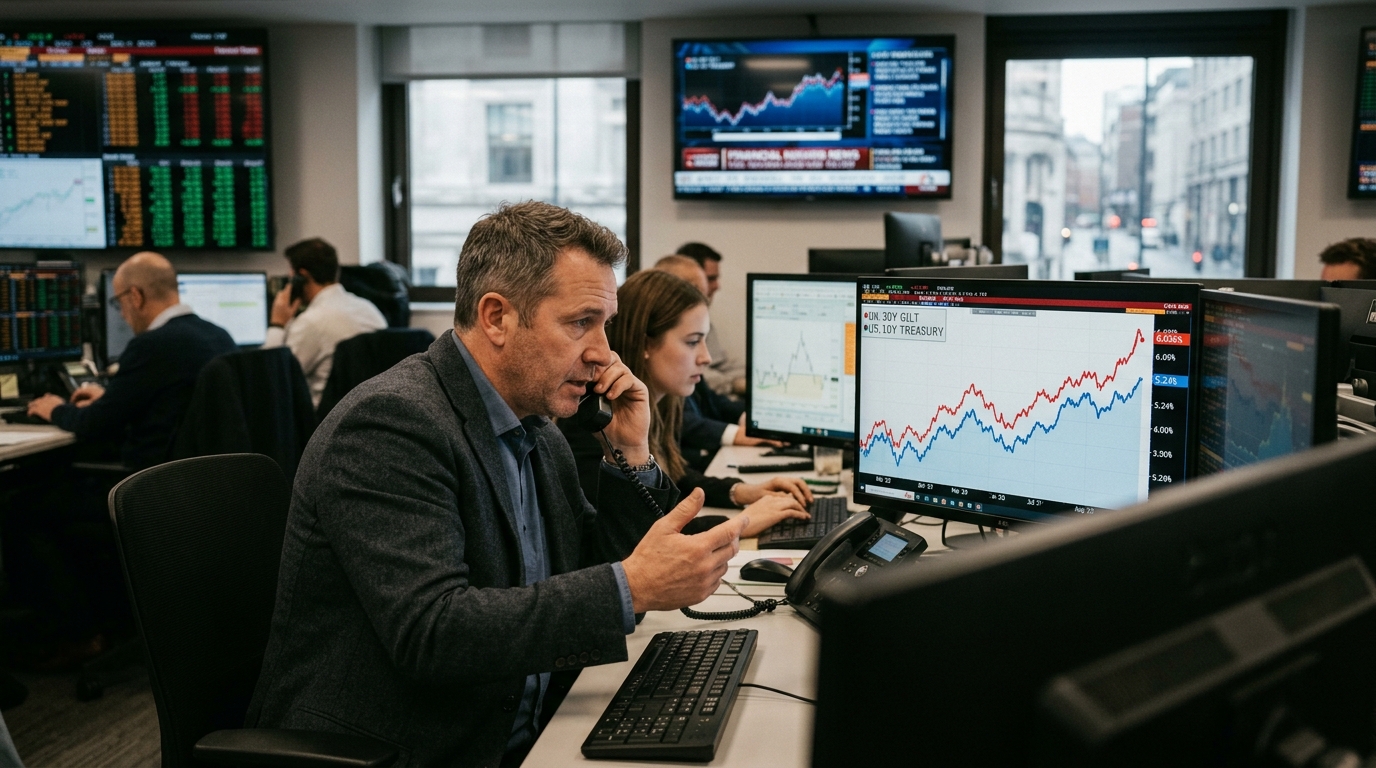

Here is something the U.S. market rarely forces investors to think about: for most of the past decade, owning U.S. stocks meant you were also long the dollar. That double exposure worked spectacularly. In 2025 and into 2026, it has started working in reverse.
The U.S. Dollar Index fell roughly 9.4% in 2025. It touched a four-year low early in 2026 before a brief bounce tied to the Middle East conflict. As of mid-June, it has not recovered meaningfully. Goldman Sachs, Deutsche Bank, and a Bloomberg survey consensus all project the DXY ends 2026 somewhere in the 98–100 range – another 3–5% below current levels.
Why it’s happening now is not complicated. The Fed is perceived as being behind the curve relative to global peers. The European Central Bank, Bank of Japan, and Bank of England are running tighter or comparable policy, which narrows the yield differential that propped the dollar up for years. Add persistent U.S. fiscal deficits, an overvalued dollar by most long-term purchasing power models, and you have the ingredients for continued gradual depreciation.
What’s interesting is what happens to international stocks when the dollar weakens. A U.S.-based investor holding foreign assets gets a currency translation boost when converting gains back to dollars. That mechanical tailwind – not just fundamental improvement – drove international stocks to outperform U.S. equities by 13.9 percentage points in dollar terms in 2025.
It is not just one region. Korea’s KOSPI was up over 30% year-to-date as of February. The Nikkei gained over 13%. Europe’s Stoxx 600 added more than 5%. The MSCI World ex USA index climbed 32.6% in 2025 alone. These are not fringe numbers. They are bigger than what most U.S. portfolios captured, because most U.S. portfolios hold near-zero international exposure.
The valuation gap makes this more interesting, not less. Emerging market stocks are trading at a forward price-to-earnings ratio of roughly 13.4 against the S&P 500’s approximately 22. International equities broadly represent only about 27.5% of the MSCI World Index today, compared to a long-term average closer to 48.7%. That is a historically extreme underweight, and mean reversion in that allocation alone could sustain international outperformance for years regardless of earnings trajectory.
Germany has embarked on a significant fiscal stimulus plan. Japan’s corporate reform wave is ongoing, with shareholder-friendly policies pushing capital returns higher. Asian markets, especially China, are seeing renewed interest from global allocators as macro conditions stabilize and AI investment accelerates regionally.
The part that gets missed: dollar weakness is not just a currency story. It reshapes relative earnings power. U.S. multinationals with heavy overseas revenue actually benefit from translation effects, which is a secondary opportunity within domestic large-caps. But the primary beneficiaries are unhedged foreign equity holders – and most retail investors in the U.S. are not positioned that way at all.
This is where I’m at on the risk side: a dollar recovery in the second half of 2026 is possible, particularly if U.S. growth data continues to outpace expectations or if the Fed signals a more hawkish path than markets currently price. Morgan Stanley flagged this scenario explicitly. If that happens, international outperformance could pause or reverse temporarily.
But the structural backdrop – fiscal imbalances, valuation differentials, policy divergence, and two decades of extreme U.S. concentration – does not resolve in a quarter. The question for investors is not whether to have international exposure. It is how long they can afford to wait before the cost of not having it shows up in their statements.