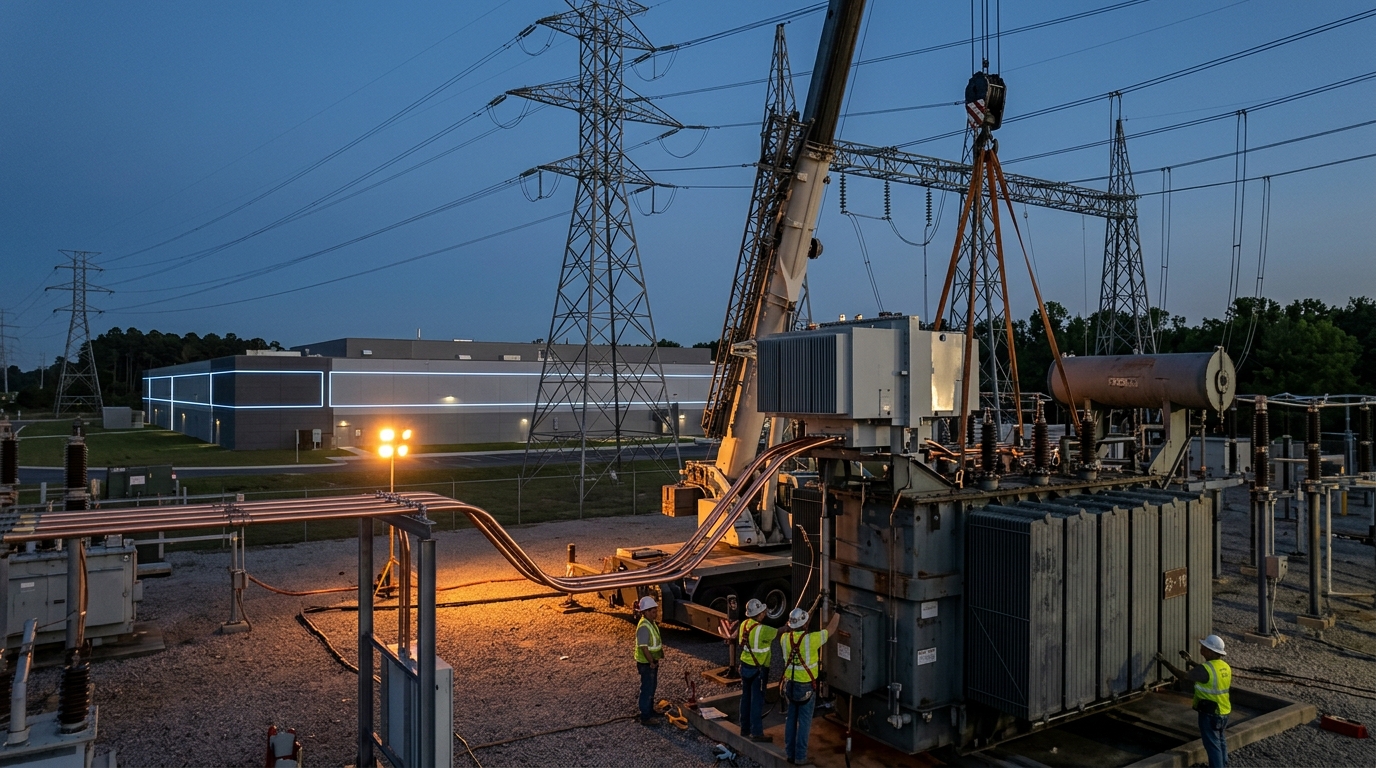
The AI buildout has a hardware problem that no software patch can fix. Federal data points to an aging U.S. grid fleet, with roughly 70% of power transformers 25 years old or older, and the loads now arriving at local substations were never part of any original capacity calculation. A single large AI training cluster can require hundreds of megawatts of continuous delivery. The nearest high-voltage upgrade, in many corridors, is six to eight years out.
That mismatch is not an abstraction. Wood Mackenzie has been cited for substation transformer lead times stretching from roughly 140 weeks in 2023 to more than 160 weeks in 2026. Annual transformer demand has also been cited by Wood Mackenzie as potentially exceeding 9,000 units by 2030, versus roughly 1,500 in the mid-2020s. An AI data center that broke ground in early 2026 and requires a 300 MVA unit may not see delivery until 2029 in a tight market. Equipment availability has replaced capital as the binding constraint.
The firms positioned best are not the transformer manufacturers. Those backlogs are spoken for. The real commercial opportunity belongs to the engineering, procurement, and construction shops that utilities are now hiring to retrofit existing substations faster and cheaper than building new ones. IEC 61850 digital upgrades, which replace copper-wired relay logic with Ethernet-based protection systems, have been presented in industry materials as cutting commissioning time by roughly 40% to 50% versus traditional substations. For a cash-constrained utility that cannot wait a decade for a greenfield solution, that is the only viable path.
Quanta Services reported Q2 2026 revenues of $9.56 billion, up 41% year-over-year, with total backlog hitting a record $53.4 billion. Its Electric Infrastructure segment is driving that expansion, fueled directly by grid upgrade awards. GE Vernova reported total orders of $7.1 billion in Q1 2026, a book-to-bill ratio of roughly 2.5, and raised its full-year 2026 revenue guidance to $45.5 to $46.5 billion. GE Vernova reported total backlog of about $176 billion as of Q2 2026.
The structural angle traders should watch is contract duration. Retrofit cycles on transmission-class substations can run multi-year timelines from initial design through commissioning and into maintenance agreements. A firm that wins the engineering contract today is also positioning for the O&M revenue that follows. That is not a project win; it is an annuity. The DOE’s roughly $1.9 billion SPARK funding program, tied to a 2026 notice of funding opportunity, listed an anticipated selection notification date of August 2026 and an anticipated award window beginning in late 2026, accelerating how fast utilities can commit capital to these awards, which means the contracting window is compressing now.
The risk is concentration. Both Quanta and GE Vernova are pricing new work at a premium because demand exceeds their current capacity to deliver. Any deceleration in hyperscale data center permitting or a sudden easing of transformer supply would reshape the backlog assumptions embedded in both stocks. For now the scarcity loop is tightening, not loosening, and the engineering firms who got into position early are the ones collecting the contracts that will still be generating revenue in 2034.