
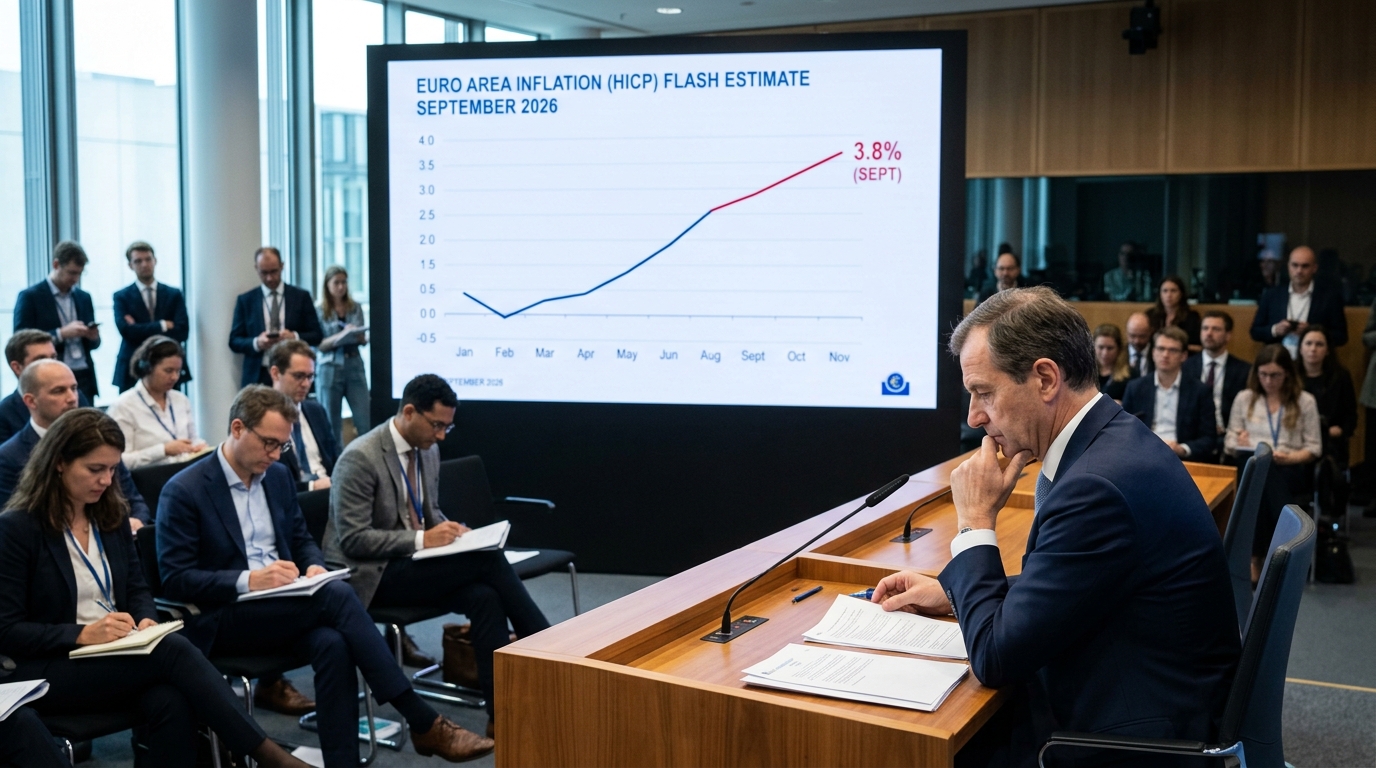
The number that landed this morning was worse than almost anyone expected. Eurostat’s flash estimate puts euro area annual inflation at 3.8% in September 2026, up from 3.2% in August. Economists polled by Reuters had penciled in 3.6%. The beat matters because it lands on top of national data that had already unsettled markets: Spain’s harmonised HICP jumped to 5.0% in September from 4.6% in August, beating the 4.9% forecast.
The driver, again, is energy. Energy is expected to have the highest annual rate in September at 18.8%, compared with 14.3% in August, followed by services at 3.2%. In Spain, the surge was driven by higher fuel prices, lubricants and package holidays, with core inflation rising 0.2 percentage points to 3.1%. That core move is the detail ECB watchers should flag: it suggests the price shock is no longer purely a commodity story.
Why the ECB’s Next Meeting Is Now a Live Event
The European Central Bank raised its key deposit rate by 25 basis points to 2.5% at its September 10 meeting. ECB President Christine Lagarde said risks to growth are tilted to the downside while inflation risks are tilted to the upside, reiterating that future decisions will be made on a meeting-by-meeting basis. That language left December technically open. Today’s 3.8% reading slams it wide open.
Goldman Sachs Research expects the ECB to hike rates in December amid resilient economic growth and inflationary pressures, taking the deposit rate to 2.75% from 2.5%. The outlook for food price inflation has also worsened since the summer following unusual weather patterns, and Goldman now expects headline inflation to peak at 3.8% in the fourth quarter. That forecast was written before this morning’s data confirmed exactly that level.
The Trade Allocators Are Actually Debating
Here is where it gets complicated for global bond managers. A hawkish ECB should, in theory, support the euro and push Bund yields higher. The Bund has already moved: the 10-year yield eased to 3.52% on October 1, though it has risen roughly 15 basis points over the past month. But the euro has not followed the script. Germany, France, Italy, and Spain all printed above forecast on September 30, data that usually supports the single currency, yet EUR/USD traded near 1.1330.
The reason is straightforward: the energy-driven inflation prints failed to lift the euro while the US 10-year yield reached its highest since 2007, leaving the rate gap in the dollar’s favor. EUR/USD is ultimately a yield-spread trade, and right now that spread favors the dollar decisively.
This is the core debate in every allocation committee today. If the ECB hikes in December and the Fed stays on hold, the spread narrows. A narrowing of the 10-year spread to 160 basis points or less would likely lift EUR/USD toward 1.1425 to 1.1500, requiring either US yields to fall or Bund yields to rise faster. Today’s inflation figure makes the Bund-yield-rising side of that equation more plausible.
What Investors Are Missing
The conversation is almost entirely about December’s rate decision. What is receiving less attention is what a 3.8% September reading does to the ECB’s full-year 2026 inflation projection. The ECB kept its 2026 inflation forecast at 3.0% while revising projections higher for 2027 and 2028. With Q4 now tracking above that annual figure, an upward revision to the staff forecast in December is likely. A higher projected path changes the terminal rate calculus well into 2027.
Stocks to Watch
- Bund futures (via European bond ETFs): The most direct expression of the December hike debate. A confirmed hike pushes short-duration Bunds lower; expectations of a pause would rally them sharply.
- EUR/USD: The spread trade is the cleanest single instrument. The pair needs US yields to soften or European yields to accelerate to break above 1.14. Today’s data argues for the latter.
- European energy majors (TotalEnergies, Eni): Energy at 18.8% annual inflation in the bloc is a revenue tailwind that is only partially priced in their multiples.
- Southern European banks (Banco Santander, UniCredit): Higher-for-longer ECB rates expand net interest margins, but the offsetting risk is slower loan growth in heavily indebted households across Spain and Italy.
- European industrials with dollar revenues: A weaker euro is a quiet earnings cushion for exporters. If EUR/USD stays below 1.14, that benefit persists through year-end guidance.