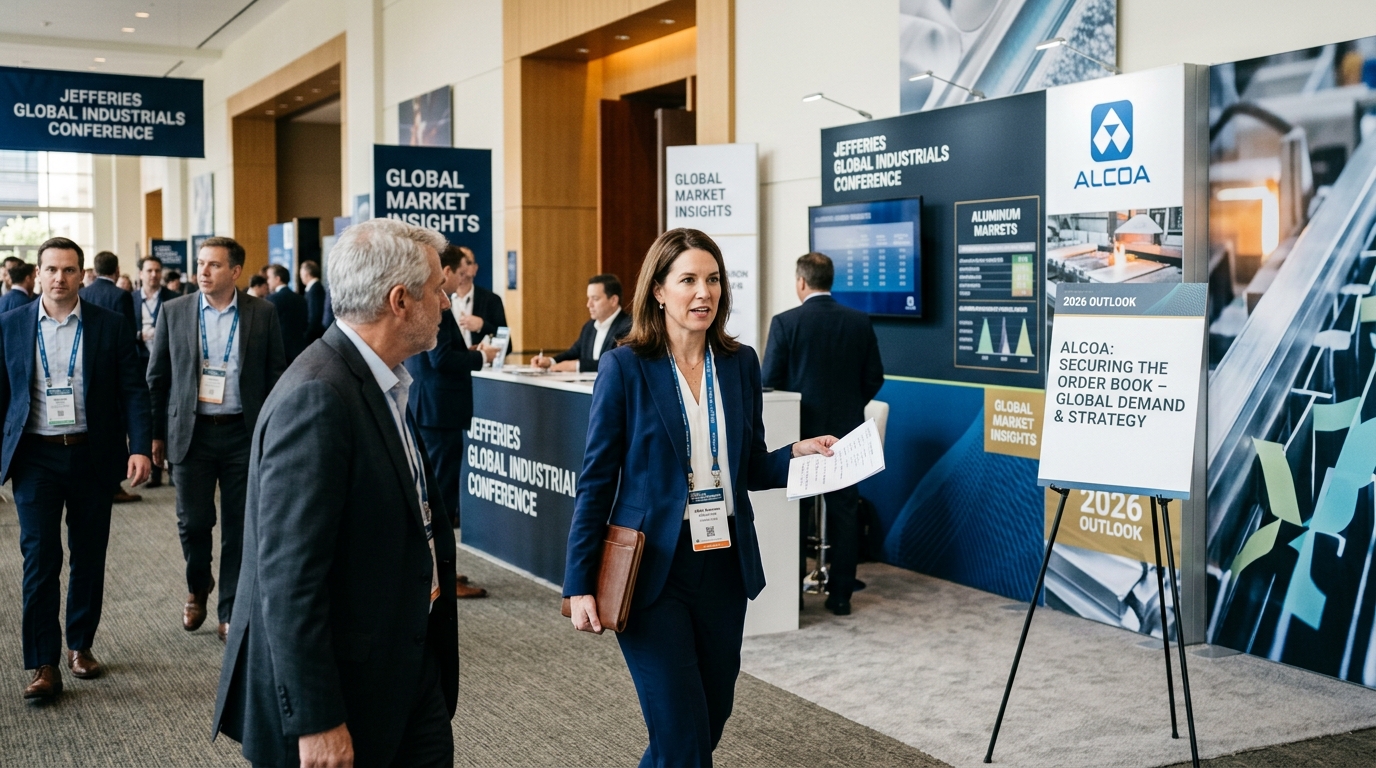
Alcoa CFO Molly Beerman walked into the Jefferies Global Industrials Conference on September 10, 2026 with a message worth paying attention to: the company’s order book is almost completely sold out for the rest of 2026, and it sees the current tariff environment as a net positive rather than a threat. That combination of physical scarcity and policy tailwinds puts Alcoa in an unusual position for a commodity producer. The question is whether the balance sheet can hold the moment together.
Why This Stock Now
Beerman said Alcoa is carrying momentum from the second quarter into the third, supported by strong production and pricing, and that the company set production records at five operations during Q2 and continued that performance into Q3. That kind of operational cadence, sustained across multiple sites simultaneously, is not routine for an aluminum smelter network of Alcoa’s geographic complexity.
Outside China, which is largely self-sufficient and whose exports are not material to the global market, aluminum markets are in overall deficit, with North America and Europe running the largest shortfalls. That is the structural backdrop. The tariff architecture is the accelerant.
The Tariff Arithmetic Others Are Getting Wrong
Beerman told the Jefferies audience that the U.S. needs to import approximately 4 million tons of aluminum annually, while Canada can supply only 3 million tons. The Midwest premium, the surcharge U.S. buyers pay above the London Metal Exchange benchmark, currently stands at $1.09 per pound, or $2,403 per metric ton.
The implication is structural, not cyclical. Beerman said that with the U.S. still needing to incentivize the import of a million tons from non-Canadian sources, even a favorable Canadian rate would not push the Midwest premium down significantly. Alcoa, which smelts in Canada and sells heavily into North American markets, captures that premium on production that already exists. It does not need to build anything to benefit.
Customers have also sought regionally located supply amid uncertainty surrounding Middle Eastern production, adding an additional demand pull that has little to do with tariff policy alone.
What’s Driving the Opportunity
Alcoa’s second quarter included record quarterly revenue, strong operational performance, and progress on multiple smelter capacity restarts. The company set year-to-date production records at four aluminum smelters and one alumina refinery, progressed multiple smelter capacity restarts, and completed new multi-year collective bargaining agreements in Australia, the U.S., and Canada. Those labor deals remove a layer of near-term operational risk that is easy to underestimate in a commodity cycle.
What Could Go Wrong
The South32 acquisition is the complication that deserves direct attention. Alcoa priced a $2.6 billion senior notes offering to help fund the cash portion of the South32 asset deal. The notes carry coupons of 6.625% and 6.875%, and they sit on top of a business that is inherently cyclical. Aluminum prices do not stay elevated indefinitely, and servicing fixed debt through a price trough is a different challenge than running lean in an upcycle.
The deal also introduces share dilution of roughly 6% from newly issued shares, a $3.1 billion cash portion of upfront consideration, and a contingent payment of as much as $750 million owed to South32 if alumina and aluminum prices exceed agreed strike prices over four annual measurement periods. That last item is structurally odd: Alcoa pays more precisely when markets are strongest, which is also when it would otherwise be accumulating cash.
Restarts at Spanish and Norwegian smelters add production volume but also add fixed cost before those operations reach nameplate capacity. Execution risk is real when you are restarting cold smelter lines in high-energy-cost regions.
The Bottom Line
Alcoa is operating in one of the cleaner commodity setups available right now: physical deficit, regional pricing power, a sold-out order book, and a tariff wall that competitors importing into the U.S. cannot escape. The production records confirm the operational machine is running. Analysts have lifted their average price target to $73.87, reflecting updated expectations for revenue and margins.
The South32 debt load is real, the dilution is real, and anyone buying AA today is also buying a leveraged bet on aluminum prices staying elevated long enough to absorb $2.6 billion in bonds. If that condition holds, and Beerman’s deficit framing is accurate, this is the one commodity stock where the fundamentals, the policy environment, and the operational evidence are all pointing the same direction at the same time.