Most analyst upgrades recycle the same AI-chip enthusiasm and call it a thesis. Tuesday’s Northland Capital Markets call on Intel is different. It names a shortage, a customer, a technology node, and a manufacturing complex backed by two of the most capital-intensive companies on the planet. That specificity is worth taking seriously.
Why This Stock Now
Northland Securities analyst Gus Richard raised his rating on Intel to “outperform” from “market perform” and set a price target of $120. Shares closed at about $104.45 on September 8, reflecting a move of roughly 9% on the session. Yet Intel is still down roughly 32% from its June peak, even after a sharp run in 2026. A pullback of that size, against a thesis that has just been freshly restated with new catalysts attached, is precisely the kind of moment this publication looks for.
The Business
Intel operates in two worlds simultaneously. Its products division sells the server and PC processors that built the company’s franchise. Its foundry arm manufactures chips for outside customers, and for years that arm has been a money pit. Intel Foundry reported $5.8 billion in second-quarter revenue and about a $2.1 billion operating loss. Intel has said only about $293 million of that came from external customers. The entire bull case hinges on whether that external revenue line can grow fast enough to justify the capital being poured in.
The processor side is already delivering. Intel said its data center and AI (DCAI) revenue grew 59% year over year in the second quarter of 2026. The company also forecast third-quarter 2026 revenue of $15.8 billion to $16.8 billion.
Why Wall Street Is Paying Attention
Two catalysts drove Tuesday’s move. First, the server CPU shortage. Intel has acknowledged supply constraints in the first half of 2026, though it has also said it expects constraints to ease over the second half. Scarcity gives Intel pricing power it has not had in years. DigiTimes has been cited in market coverage as reporting that Intel is planning another round of PC CPU price increases of about 10% starting in early October.
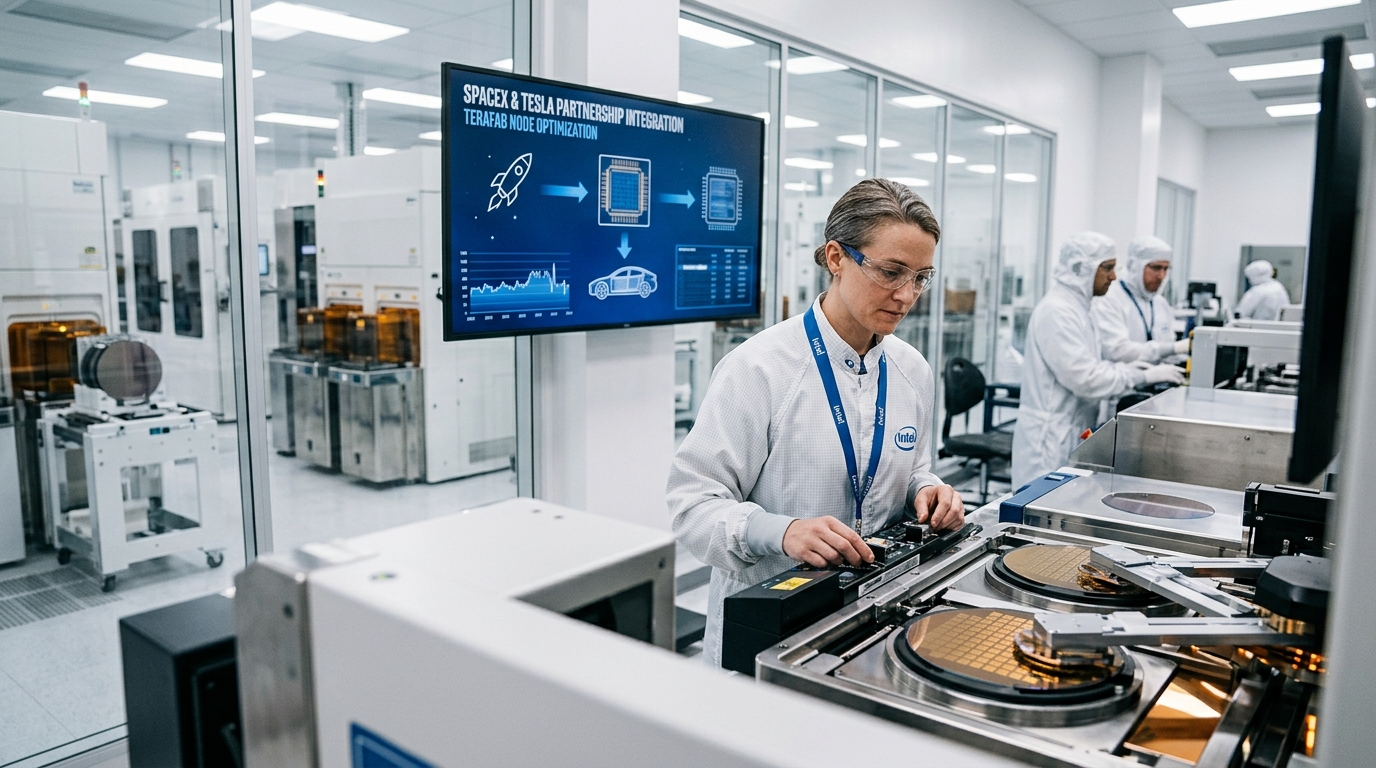
Second, Terafab. Intel has been linked in recent reporting as a key manufacturing partner on Terafab, a chip effort backed by Tesla and SpaceX that has been described as targeting one terawatt of compute per year over time. Some coverage has also associated xAI with the broader Musk ecosystem around Terafab. The ambition is enormous, and the market is treating it as a credibility signal for Intel Foundry.
There is also a manufacturing milestone behind the upgrade. Intel said this week that it has processed more than one million wafers using ASML’s High NA EUV technology, a utilization milestone that points to accumulated process learning, even if it does not mean one million finished commercial product wafers.
What Could Go Wrong
Terafab’s timeline is long, and the scale implied by early descriptions would take years and tens of billions of dollars to build. Even if the strategic logic is sound, it is not a near-term earnings driver.
The foundry unit is also still deeply unprofitable, and a stock that has already had a big year requires execution to keep pace with expectations. Any miss on the October earnings date, which is currently expected around October 22, 2026, could reset sentiment sharply.
The Bottom Line
Intel is not a speculation on AI sentiment. It is a bet on three converging specifics: a CPU market where supply has been tight, a price-hike cycle that could restore margins, and a foundry effort tied to Terafab that would represent a new type of demand signal for Intel Foundry. The $120 target implies roughly 15% upside from Tuesday’s close. As Richard argued in his upgrade, aligning with Terafab could validate Intel’s push into external foundry services. That is the case in one sentence. The stock’s pullback from its June peak makes today’s entry more defensible than chasing it at the highs. Of every name in semiconductors right now, Intel is the one where the catalyst is named, the customer is real, and tightening supply is showing up in pricing chatter.