Start with the force, not the stock.
America is in the middle of the largest domestic manufacturing build-out in a generation. Reshoring and foreign direct investment brought 244,000 announced manufacturing jobs back to the U.S. in 2024 alone — the second-highest annual figure on record — and the pace has not slowed. Since 2010, the cumulative total has surpassed 2 million jobs. That’s not a trend. That’s a structural reset.
Here’s what most investors are missing about those numbers.
These aren’t assembly line jobs from the 1970s. 88% of the jobs announced in 2024 were classified as high-tech or medium-high-tech manufacturing. These facilities run advanced robotics, AI-driven quality systems, and connected production lines from day one. They don’t hire a hundred workers to inspect parts by hand. They buy machines that see.
That’s the second-order effect nobody is pricing correctly.
The first-order headlines are about which chipmaker is reshoring, which EV battery plant just broke ground, which semiconductor fab just received CHIPS Act funding. Those stories are everywhere. What isn’t in those stories is the infrastructure that every single one of those facilities has to purchase before a single product rolls off the line. And at the very top of that list — quietly, without fanfare — is machine vision.
The Factory Has to See Before It Can Work
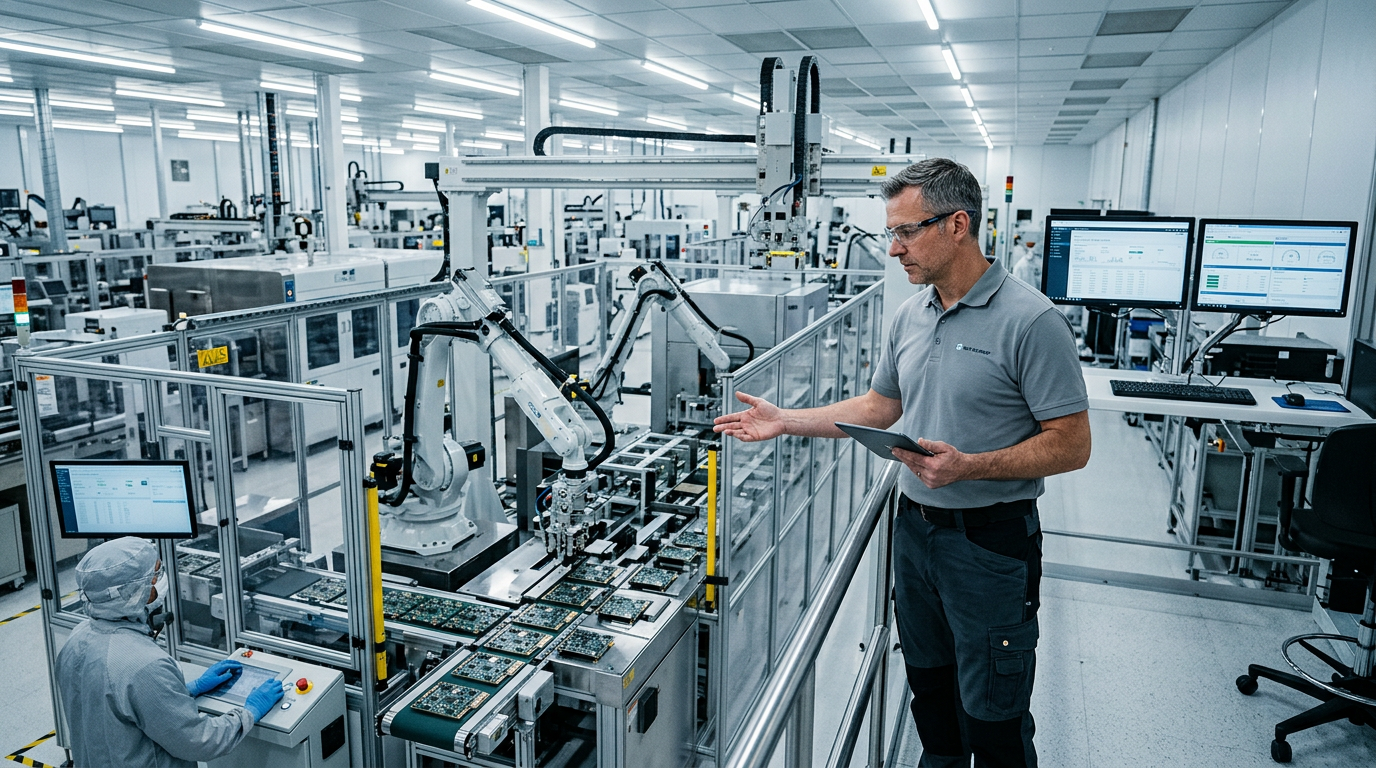
Think about what a modern factory actually does. It assembles things, tests things, moves things, and rejects defective things. Every step in that chain requires the facility to perceive its environment with precision that no human worker can match at scale. A robot arm grabbing a semiconductor component needs to know the exact position and orientation of that part. A production line at a battery plant needs to catch a defective cell at 2,000 units per hour without slowing down. A reshored electronics facility producing for a major tech customer needs zero-defect output or it loses the contract.
All of that runs through machine vision — the cameras, sensors, and AI software that give factory equipment the ability to see, identify, inspect, and decide.
The market is not small. Factory automation and machine vision was a $90 billion global market in 2024 and is projected to reach $150 billion by 2033, growing at roughly 6% annually. But that top-line figure masks something important: the growth rate is accelerating at exactly the moment when the largest wave of new factory construction in decades is hitting. You’re not just getting baseline demand. You’re getting a pull-forward of demand from thousands of facilities that need to be equipped from scratch.
Slight tangent, but it matters: the labor math is making this worse, not better. The U.S. construction industry requires an estimated 425,000 new workers in 2026 alone just to balance supply and demand in the skilled trades. Manufacturers are facing chronic labor shortages in exactly the people who would traditionally do manual inspection. That accelerates the decision to automate quality control. Every worker shortage is a machine vision sale.
The Company Most Positioned to Capture It
There’s one company that has been doing this longer than anyone else, holds the dominant market position, and is in the middle of a strategic transformation that Wall Street has been slow to recognize.
Cognex Corporation (NASDAQ: CGNX) is the global leader in industrial machine vision. Its vision systems and barcode readers guide robots, check quality on production lines, and track goods in logistics. The business was built over four decades on a simple proposition: factories need eyes, and Cognex builds the best ones.
For a few years, the stock was in purgatory. The logistics boom of 2021-2022 created outsized demand, then cooled sharply. Consumer electronics and semiconductor customers pulled back. The stock fell roughly 60% from peak to trough, and a lot of investors walked away assuming the cycle had simply peaked.
That assumption is being dismantled in real time.
The Numbers That Change the Conversation
Cognex just reported Q1 2026 results on May 6, and the print was not subtle. Revenue increased 24% year over year, reaching $268.4 million and surpassing consensus estimates of $246 million. Adjusted EPS of $0.34 beat the $0.25 estimate by 36%. Those are not incremental beats. They represent a genuine inflection in demand.
What’s interesting is the margin story running alongside the revenue story. Adjusted EBITDA margin reached 26.9%, expanding 1,010 basis points year over year — marking the seventh consecutive quarter of margin improvement. Operating margin expanded to 22.3% from 12.1% a year earlier. The business was running lean through the downcycle, and now leverage is hitting hard as volume returns.
Management guided Q2 2026 revenue of $280 million to $300 million, implying roughly 16-20% year-over-year growth at the midpoint. Adjusted EBITDA margin guided to 28%-31%, another significant step up. The company also expects to achieve $35-40 million in annualized net cost reductions by end of 2026, which hasn’t fully shown up in the consensus yet.
The seven-consecutive-quarter EPS growth streak. The four straight earnings beats. This isn’t a bounce. It’s a rerating in progress.
The AI Layer That Makes This More Than a Cyclical Recovery
The part people are underweighting is what Cognex just built on top of its hardware business.
In late April and early May 2026, the company launched two breakthrough AI vision platforms: the In-Sight 6900, powered by NVIDIA Jetson technology, and the In-Sight 3900, an embedded AI vision system powered by Qualcomm Dragonwing platforms. Both integrate with OneVision — Cognex’s cloud-to-edge AI ecosystem — which allows manufacturers to develop and deploy vision models once and push them across hundreds of global production sites simultaneously.
Here’s where it gets interesting. The historical bottleneck in machine vision wasn’t the hardware. It was the setup. You needed specialized engineers to program the detection rules for every single inspection task. That constraint limited how broadly vision could be deployed, especially in smaller facilities. OneVision’s Edge Learning platform is eliminating that bottleneck — a line operator presents a handful of good parts and bad parts to the camera, and the device trains itself in minutes. No data scientist required.
That changes the addressable market. Millions of inspection points that were previously too expensive to automate are suddenly viable. And Cognex is building the ecosystem lock-in to own that expansion.
The CEO at Automate 2026 in Chicago said it plainly: the company’s stated objective is to become the number one provider of AI-powered machine vision. That’s not repositioning language. That’s a description of what the product roadmap now actually supports.
Why Isn’t CNBC Talking About This
Fair question. A few reasons.
First, Cognex is a $15-16 billion market cap company — large enough to avoid the speculative conversation, small enough to miss the mega-cap coverage cycle. It doesn’t make headlines at a scale that feeds the algorithm.
Second, the last narrative attached to Cognex was the logistics boom collapse. Investors who got burned in 2022-2023 aren’t in a rush to revisit. The mental model is stale.
Third, the real story here is derivative. Cognex doesn’t benefit directly from a tariff announcement or a chip fab groundbreaking. It benefits three steps later, when that facility needs to be equipped. Those second-order effects take months to show up in order books, and Wall Street is not patient enough to track them before they materialize in earnings.
The reshoring build-out is creating a multi-year capex cycle across thousands of domestic manufacturing facilities. Every one of them needs vision systems. Many of them are being designed from scratch with automation at the core. That’s not a quarterly story. It’s a structural demand driver that hasn’t been fully priced into a stock still trading well below its 2021 high.
Options Market Context
For traders looking at the structure, Cognex’s Q2 2026 report arrives in early August. Management guided a wide range of $280 million to $300 million in revenue — that’s the signal to watch. If the top end is met, margin leverage will accelerate into H2. The stock has already moved roughly 18-19% following the Q1 beat in early May, suggesting the market is beginning to reprice the thesis but has not yet finished doing so.
For investors expecting continued fundamental acceleration, a defined-risk structure that captures the August earnings window allows participation in the thesis without uncapped downside if macro conditions shift. The IV environment following a significant post-earnings move can sometimes offer favorable entry points for longer-duration exposure.
The Risk Checklist
- Competition: Asian machine vision competitors are undercutting on hardware pricing. The OneVision ecosystem is the moat — its durability depends on execution of the software transition.
- Customer concentration: Cognex has historically had meaningful exposure to Apple supply chain. Any iPhone production shift creates near-term volatility.
- Cycle timing: Reshoring facilities take 18-36 months from groundbreaking to equipment purchase. The full demand pull may not hit until 2027-2028.
- Valuation: At roughly $65 per share post-Q1 beat, the stock is not cheap on a trailing basis. The bull case is forward-looking and requires execution on the AI product roadmap.
The part people skip: Cognex is the only pure-play, publicly traded, large-scale AI machine vision company in North America. Every robot deployed in every reshored factory needs guidance. Every automated quality inspection line needs eyes. The physical AI wave Jensen Huang keeps talking about — the $40 trillion addressable market — runs on sensor infrastructure that Cognex has spent four decades perfecting.
The factory of the future is getting built right now. It just needs to see first.