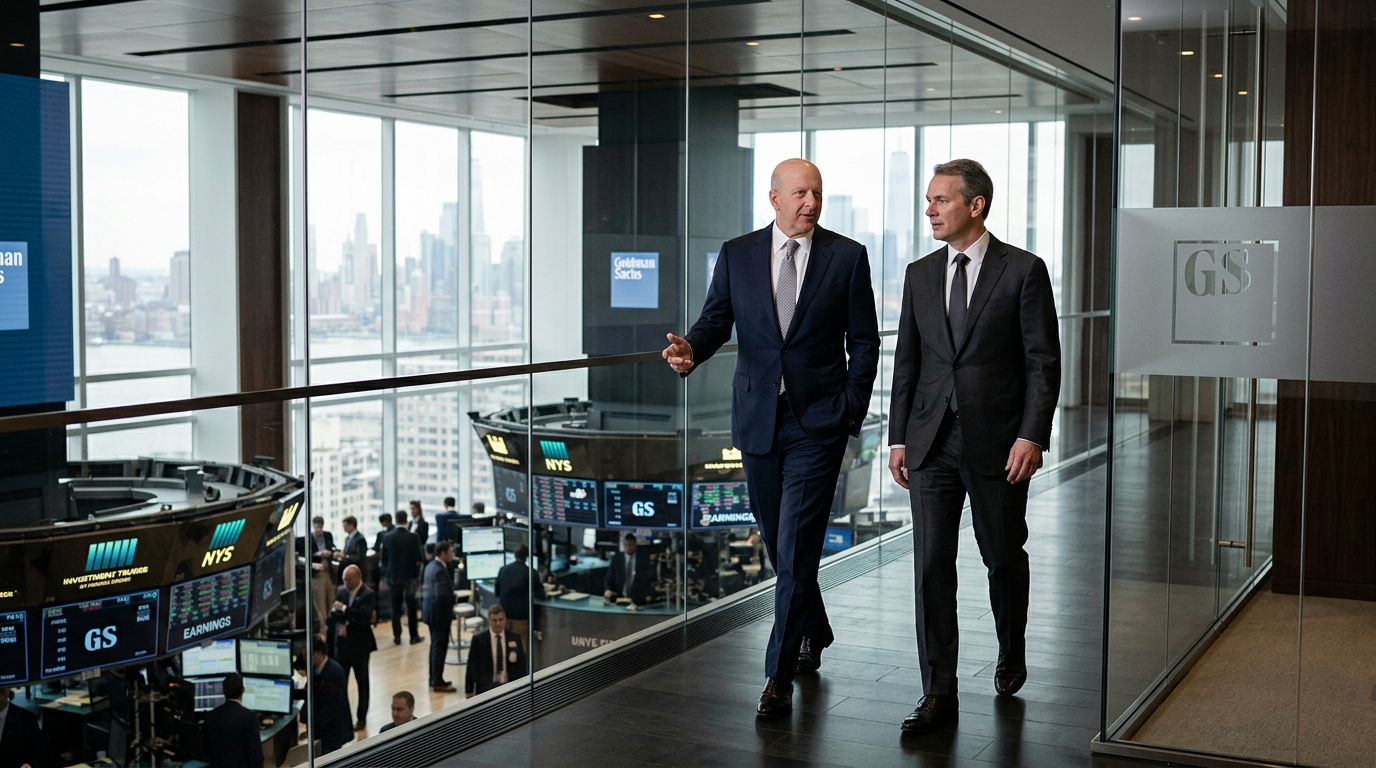
Wall Street spent Tuesday pricing Goldman Sachs on a leadership story that, viewed through any long-term lens, changes almost nothing material. Reports emerged on September 28 that Goldman’s board is considering a succession plan in which COO John Waldron would take over from David Solomon as early as next year. Shares sold off alongside peers as longer-dated Treasury yields kept pressure on the entire bank group. The real question isn’t who occupies the corner office. It’s whether the franchise that generated those results is in any way impaired by the transition. It isn’t.
The Numbers Define the Moment
Goldman reported second-quarter net revenues of $20.34 billion and diluted EPS of $20.98, with an annualized return on equity of 23.5% and book value per share rising to $367.67. That is not a business in need of rescue. The engine room was Global Banking and Markets, which posted record equities revenue of $7.42 billion, up 72% year-on-year, alongside a 55% jump in investment banking fees. Goldman has said it crossed $1 trillion in announced M&A volumes over a six-month period earlier this year. Those figures reflect structural advantages, not individual charisma.
Solomon took the helm in October 2018. He got Goldman back on track after a costly foray into consumer banking, and with help from a deals rebound and the artificial intelligence boom, Goldman is once again a clean story for investors as the top pure-play investment bank. The turnaround is complete. The hand being passed is a strong one.
Waldron Is Not a Gamble
Goldman’s board learned in late 2024 that Waldron had engaged in serious talks with Apollo Global Management and several other firms actively seeking to recruit him. To keep him, the board offered an $80 million retention package, disclosed in January 2025 and tied to a five-year commitment. Firms don’t write that kind of check for someone they haven’t already decided will run the place.
Waldron, the bank’s president and chief operating officer, is the frontrunner to take over around the end of 2027 or in 2028. If a transition is finalized, discussions have also contemplated Solomon stepping down as CEO and then remaining in a senior role for a period of time, but any timeline remains unconfirmed. Any discord is more likely to come from power struggles at the level below CEO, where senior bankers will jostle for positions of long-term influence, but that is a normal feature of succession at any large financial institution, not a structural threat to the franchise.
One risk deserves acknowledgment: Solomon may not be ready to give up his seat, and Waldron may not be willing to wait for it indefinitely. That tension is real. It is also the kind of organizational dynamic that resolves itself, one way or another, without permanently damaging an institution of this scale.
Capital Returns Anchor the Investment Case
For investors who own Goldman as a long-duration compounder, succession planning is background noise. The foreground is capital allocation. In July, the firm announced it would increase its quarterly dividend from $4.50 to $5.00 per share, representing an 11% increase from prior levels. In the second quarter alone, the firm repurchased $4.00 billion of common stock and paid out $1.36 billion in dividends. That dividend hike marks 14 straight years of dividend growth.
Goldman is scheduled to report third-quarter 2026 results on October 13, before the open, though the company has not yet confirmed the date. Analysts expect quarterly earnings of about $15 to $16 per share on revenue of roughly $17 billion, based on current consensus estimates. The bar is meaningful but the operating backdrop, deep M&A pipelines and elevated trading volumes, has not collapsed.
What Investors Should Actually Monitor
The October 13 report matters far more than the boardroom calendar. Watch whether equities revenue sustains near recent levels, whether the M&A backlog converts into fees, and whether buyback pace holds. Insider selling over the past three months has totaled roughly $1.1 million, modest in the context of Goldman’s market capitalization and not a red flag on its own, though worth tracking as succession plans firm up.
Well-run institutions execute leadership transitions routinely. Goldman has done it before. The firm is not changing its business model or ceding its franchise position in investment banking. It is placing a 30-year institutional veteran at the top of one of the most profitable banks on the planet. The dividend keeps growing. The buybacks keep running. A new name on the door is not a reason to rethink a position built for the long haul.