
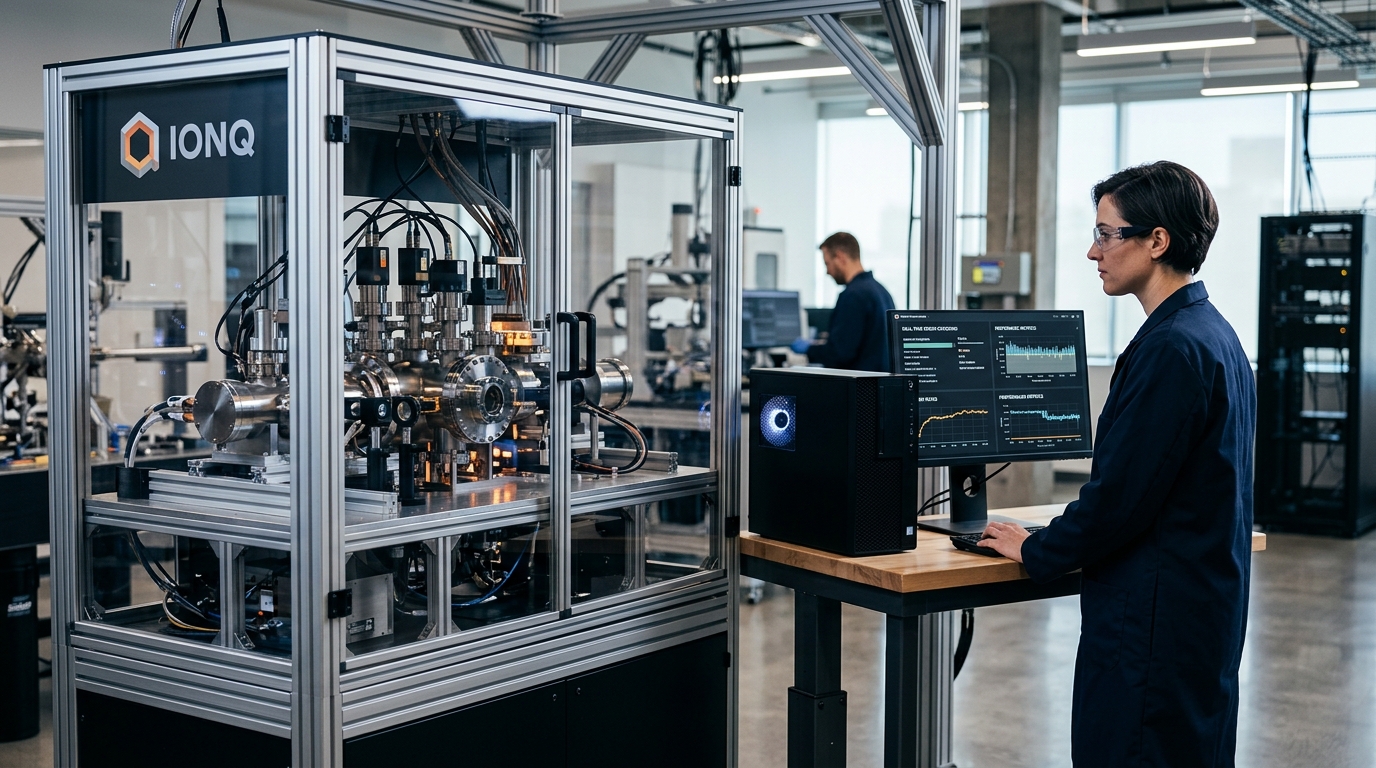
The result that landed Tuesday deserves a careful read before the reflex buy or the reflex dismissal. IonQ demonstrated what it calls the industry’s first end-to-end real-time quantum error correction decoder running on a single standard, off-the-shelf CPU. The system was tested on benchmark circuits simulating up to 408 logical qubits across 88 memory blocks and magic factories, executing more than 31.5 million individual quantum operations. Under standard operational noise, the decoder added as little as 0.02% stretch time, meaning it introduced no meaningful delay to the overall computation. That last number is the one to hold onto.
The Business
IonQ builds trapped-ion quantum computers and sells access to them through cloud platforms including AWS, Microsoft Azure, and Google Cloud, plus direct hardware deployments. The breakthrough is tied to IonQ’s roadmap toward industrial-scale quantum computing. The company has broadened its model considerably: in January it announced a deal to acquire SkyWater Technology, and on July 31, 2026 it said the acquisition had closed, describing the combined company as a vertically integrated, full-stack quantum platform spanning fabrication through cloud delivery.
IonQ reported record second-quarter 2026 revenues of $80.1 million, a 287% year-on-year increase. For the full year, the company now expects revenue between $450 million and $460 million. That guidance revision came ahead of the company’s September 8, 2026 Investor Day and was framed as reflecting both platform traction and the manufacturing scale it says SkyWater adds.
Why Wall Street Is Paying Attention
IonQ closed Wednesday at $42.54, up 4.42%, after the real-time error-decoder announcement and news of an NVIDIA Accelerated Quantum Research Center deployment, with trading volume around 72.6 million shares. The stock had surged more than 11% premarket before giving back roughly half the move during the session, all while the S&P 500 fell 0.75% and the Nasdaq Composite fell 1.13%. Relative strength that pronounced on a down day means institutions were not just reading a press release, they were adding.
Some coverage of Wall Street research has pointed to bullish views from B. Riley and Jefferies, with price targets as high as $100. However, those targets and the specific language around any path to $1 billion in annualized revenue vary by report and timing, so treat them as directional sentiment rather than a single, clean consensus datapoint.
What’s Driving the Opportunity
The error-correction result matters for a specific reason: it removes a constraint that every competing architecture shares. In conventional approaches, the classical computers tasked with decoding errors can become overwhelmed, creating a processing bottleneck that forces the quantum computer to pause and wait. IonQ’s work argues that a single, standard computer processor can manage this workload continuously in the background, keeping the quantum system running at full speed. Doing that at the scale of 31.5 million operations without slowing execution is architecturally significant, not just a marketing claim.
IonQ was also lifted by its plan to deploy a Superion 256 system at NVIDIA’s Accelerated Quantum Research Center, which connects the company’s hardware roadmap to one of the most credible distribution channels in enterprise computing. Two major catalysts in one week is not common.
What Could Go Wrong
The case against is straightforward and it is not trivial. At Wednesday’s close of $42.54 and with shares outstanding that can move around with issuance, the exact price-to-sales multiple depends on which revenue basis you use and which share count you assume. Still, the broad point holds: the stock is priced for major growth, not for current profitability. Losses from operations were $608.8 million for the first half of 2026, and as of June 30, the accumulated deficit stood at about $2.26 billion. IonQ is burning real cash to fund genuine science, but the gap between current revenue and the valuation the stock commands requires a belief in a timeline that could easily slip.
IBM and D-Wave are pursuing different quantum architectures, and it remains anyone’s guess which might ultimately prove most competitive, even if IonQ appears to be ahead now. Science is advancing faster than revenue, and revenue faster than profit. IONQ, RGTI, QBTS, and QUBT routinely move double digits on little incremental news, and drawdowns of 50% or more have happened repeatedly.
The Bottom Line
IonQ is the most compelling pure-play quantum name available today, and Tuesday’s result gives that view more technical foundation than it had a week ago. The error-decoder work is not presented as a roadmap promise; IonQ says it tested the end-to-end pipeline on benchmark circuits at a commercially relevant scale. Revenue growth of 287% year-on-year, a $450 million to $460 million full-year target, and now an NVIDIA research-center deployment give the bull case three legs to stand on simultaneously.
With large cumulative losses and an accumulated deficit approaching $2.3 billion, this is still a speculative position, not a value one. Size it accordingly. But among quantum stocks, IonQ is the one where the science is catching up to the story fastest right now.