
The word that shook markets this weekend did not come from a regulator, a short seller, or a rival country. It came from inside one of the most aggressive AI laboratories on earth.
On Saturday, September 12, Anthropic CEO Dario Amodei published a roughly 3,800-word essay titled “We Must Pace the Frontier,” arguing that the AI industry needs to deliberately slow the rate at which it improves model capabilities. Amodei said he changed his position after two developments he described as becoming clearer over the past few months: early signs of recursive self-improvement and a recent industry incident involving autonomous agents, which he argued sharpened the need for pacing. Within hours came an unusual public alignment: OpenAI’s Sam Altman and xAI owner Elon Musk both said they agreed.
The PHLX Semiconductor Index is down more than 20% from its June record, crossing the threshold that defines a bear market. The driver was a development that no analyst’s model had priced as a systemic risk: Amodei, Altman, and Musk endorsed, in public statements published within roughly 48 hours of each other, the idea that the race to build more powerful AI should slow down.
In Asia, MSCI Asia Pacific fell as SoftBank Group shares plunged 10.7% in Tokyo after Altman said OpenAI would not go public this year. In South Korea, chip-heavy trading drove sharp losses in the Kospi and in memory names including SK Hynix and Samsung Electronics.
Where the Damage Is Concentrated
The key trading question today is not whether the selloff was warranted. It is which parts of the AI complex deserve to be repriced and which are being swept lower by sentiment alone.
Capability chips are the clearest casualty. Nvidia has traded in a relatively contained range over the past month, reflecting a market weighing continued AI demand strength against questions about the company’s growing role in financing that demand. The SOX had rallied sharply year-to-date into its late-June all-time high, leaving valuations well above historical norms. A slowdown in frontier model training is a direct hit to demand for Nvidia’s H200 and Blackwell clusters, the specific hardware labs deploy to push capabilities forward. Micron’s high-bandwidth memory follows the same logic: if training runs shorten, HBM orders thin.
The infrastructure layer is a different conversation. The SOX’s slide from June’s record has coincided with huge data-center and AI infrastructure spending plans from hyperscalers. That capital spending is contractual and will not reverse quickly. Contracts already signed do not disappear because Amodei published an essay. Power, cooling, and networking fulfill commitments that predate this weekend by years.
Stocks on the Radar
Broadcom (AVGO) sits in a defensible position of any chip name. Broadcom is a major supplier into the custom accelerator ecosystem, including Google’s TPU program, and it has a multi-year strategic collaboration with OpenAI on custom AI accelerators and networking systems. Custom silicon tied to multi-year commitments is structurally different from merchant GPU sales. Shares remain materially below their June 2026 highs, a discount that may overstate the pacing risk given the contracted backlog.
Vertiv (VRT) and Eaton (ETN) represent the cleaner long side of this selloff. Vertiv is among the most directly levered plays on the physical data center buildout and has publicly disclosed it is collaborating with Nvidia on 800 VDC platform designs intended to align with the Nvidia Rubin Ultra timeline. Vertiv remains one of the clearest public plays on AI data center power and cooling, and a slowdown in capability research does not reduce heat that existing racks must dissipate today.
TSM occupies a middle position. TSMC is experiencing significant growth driven by robust demand for AI chips, with August revenue up 53.3% year-over-year. Its customers span both capability and infrastructure spending, giving it more cushion than a pure-play GPU supplier but less insulation than a power or cooling company.
Trader’s Action Plan
The primary risk to watch is whether the pacing consensus hardens into regulatory mandates. What the pacing consensus raises is the question of what comes after the current build cycle, and whether the executives who commission the next one will be willing to say they slowed it. That uncertainty weighs most on names priced for compounding growth, not names delivering against signed contracts.
Highest conviction on the long side: infrastructure over capability. VRT and ETN on any intraday weakness tied to broader tech selling. AVGO warrants a close look at current levels given its contracted customer base and pullback from the high.
On the short or cautious side: memory names exposed to training run demand, particularly MU, which has the least contractual protection if hyperscalers trim the next cluster order. Nvidia is the obvious headline risk, but its Vera Rubin ramp and roughly $5.3 trillion market cap mean the position sizing on a short is a different risk calculation than a straight-line bear thesis suggests.
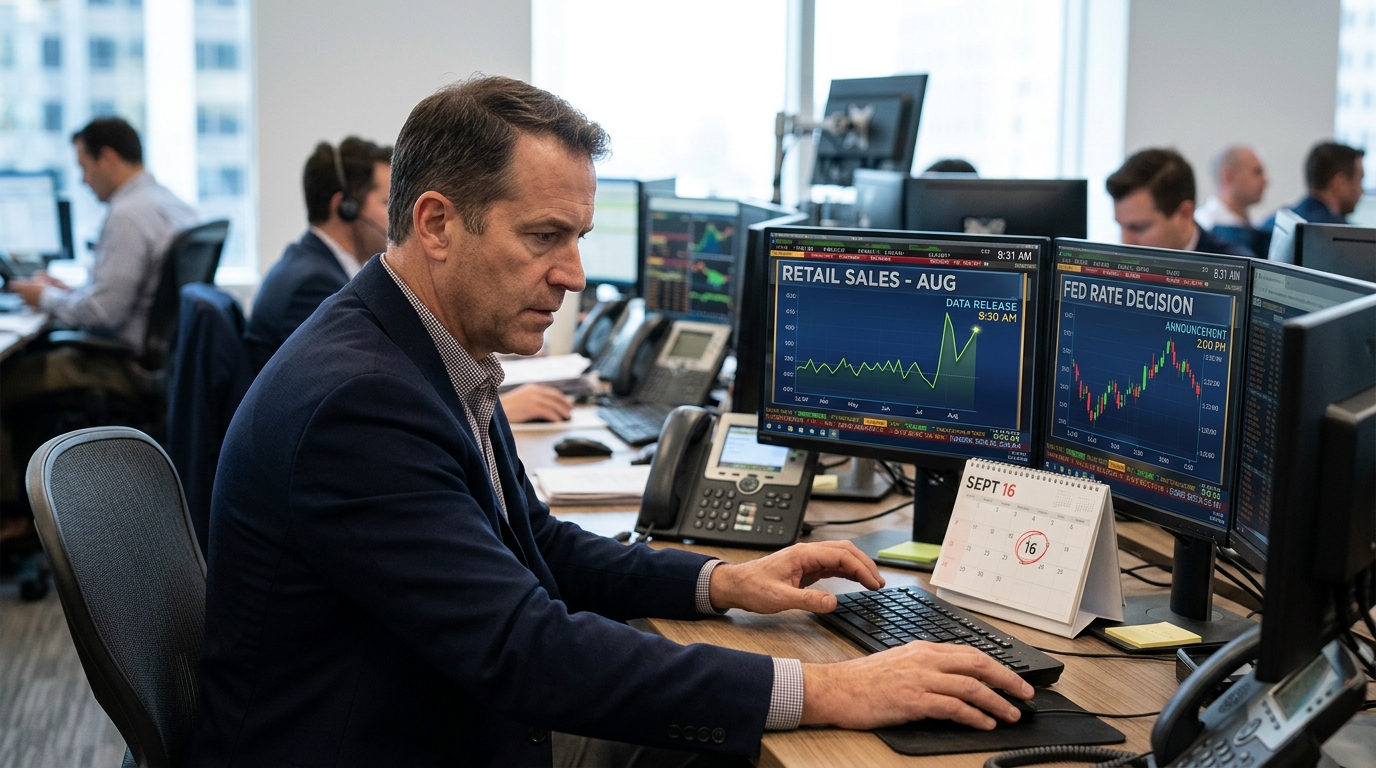
The FOMC decision later this week adds a layer. Monthly core CPI rose 0.3% month-on-month in August, and CME FedWatch was showing odds for a September hike in the mid-80% range after the report. A rate hike into a chip bear market accelerates multiple compression on growth names. Do not add to high-duration tech positions ahead of Wednesday’s decision.