There is a gap between what Constellation Energy is doing operationally and what the stock price is saying. That gap is now about $170 per share.
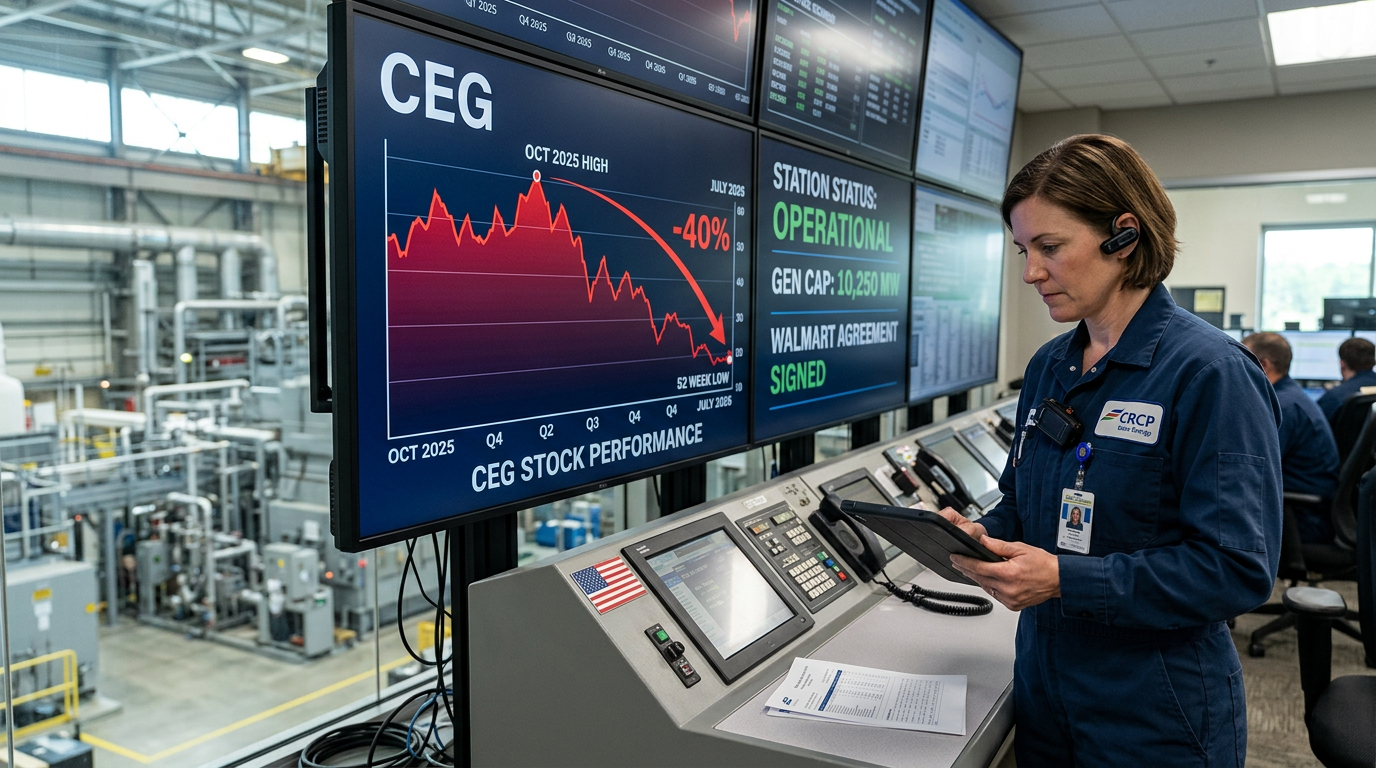
Constellation Energy (CEG) hit an all-time high of $412.58 in October 2025. It’s currently trading around $239. The company has since beaten Q1 2026 earnings estimates, reaffirmed full-year EPS guidance of $11 to $12, signed a long-term nuclear power purchase agreement with Walmart, projected $8.4 billion in free cash flow generation for 2026–2027, expanded its share repurchase authorization to $5 billion, and filed for license renewals on multiple plants. The stock is down anyway.
This is the kind of divergence that creates opportunity — or confirms that the market knows something the headline numbers don’t.
What the Numbers Actually Say
Q1 2026 was not a soft quarter. Constellation reported adjusted operating EPS of $2.74 against a consensus estimate in the mid-$2.50s — a beat of more than 5%. GAAP EPS came in at $4.49. Revenue hit $11.1 billion versus an estimate around $8.5 billion, a massive delta driven in part by the Calpine acquisition. Nuclear generation came in at 40 million megawatt hours with a 92.3% capacity factor.
Full-year adjusted operating earnings guidance was reaffirmed at $11.00 to $12.00 per share. Q2 2026 analyst consensus is sitting at approximately $2.4 EPS. The next earnings report is expected July 30.
The company operates the largest nuclear fleet in the United States — 21 reactors across 12 nuclear plants, with companywide capacity often described at roughly 55 gigawatts across nuclear, natural gas, wind, solar, hydro and other sources. It serves about 80% of the Fortune 100. That is not a business at risk of irrelevance.
The Walmart Deal Changes the Conversation
In late June, Constellation and Walmart announced a long-term nuclear power purchase agreement for emissions-free electricity from Constellation’s Dresden Clean Energy Center in Illinois. Walmart is going nuclear for the first time. The arrangement is structured as two 15-year terms beginning in 2029 and 2030 — the kind of long-duration, predictable revenue that traditional utilities almost never see from their largest customers.
This follows the 2024 Microsoft agreement — a 20-year deal tied to restarting Three Mile Island Unit 1 (now referred to as the Crane Clean Energy Center) in Pennsylvania, with Constellation estimating it would invest about $1.6 billion to restart the reactor. Constellation has also been positioning parts of its generation fleet to serve data center clients.
Slight tangent, but it matters: the broader nuclear power market is being reshaped by AI data center demand. Morgan Stanley holds an Overweight rating with a $364 price target. 20 of 23 analysts rate CEG a Buy. The consensus 12-month price target is $357.81 — implying roughly 50% upside from current levels.
So Why Is It at $239?
A few things. Rate sensitivity is one. Higher-for-longer interest rates can compress utility-style valuations. The company’s beta is commonly shown around ~1.1 on major quote services, meaning it doesn’t trade defensively even though it’s effectively a nuclear utility. The Calpine acquisition added scale but also added complexity and integration risk. Citi cut its price target to $297 from $348.
Then there’s the valuation question. Even at $239, CEG trades at a forward multiple that reflects a data center premium built into expectations over the past year. If those contracts don’t arrive on the timeline the market assumed — or if power prices soften — the premium compresses. The stock already fell from $412 to $228 once this year, finding its 52-week low in the process. That kind of range tells you the market hasn’t fully decided what this business is worth.
What’s interesting is that Constellation has outlined an aggressive long-term growth framework, including targeting 20% compound annual growth in base earnings through 2029. If additional large corporate nuclear PPAs start getting signed at scale — and Walmart suggests the pipeline is real — the earnings picture could look materially different from what consensus models are pricing.
Options Market Structure Into July 30
CEG has historically shown meaningful post-earnings price moves. Following its Q1 May 11 report, the stock declined 1.3% the following day and has drifted roughly 16% lower in the 29 days since — suggesting that even a beat wasn’t enough to hold the price, and that the broader selloff in rate-sensitive and AI-adjacent equities has weighed more than the earnings quality.
For traders watching July 30: implied volatility in CEG options tends to rise into earnings and compress sharply afterward — a dynamic that rewards premium sellers who position before the report and exit quickly after. At a stock price near $239 with the 52-week low at $228.63, the downside floor isn’t far off. That asymmetry matters.
Structured Trade Frameworks
Bull case: If you believe that nuclear AI power deals continue signing, that the Calpine integration delivers on synergies, and that the July 30 earnings report shows Q2 results in-line or better — a risk-defined structure here would be a bull call spread, buying the August $240 call and selling the August $270 call. This captures a move toward the mid-range of analyst targets with defined downside.
Bear case: If rate headwinds persist and no new data center contracts are announced, the path back toward $228 is not long. A bear put spread — buying the August $235 put and selling the August $215 put — defines risk while targeting the lower end of the recent range. The 52-week low is nearby support, and a break below it would be technically significant.
Neutral case: If the stock continues to chop between $228 and $260, IV crush after earnings favors a premium-collection strategy. An iron condor around those levels captures elevated pre-earnings vol in a defined-risk structure.
Forward Outlook
The company applied for license renewals for two New York nuclear plants through 2049. It’s targeting 20% base-earnings growth through 2029. The free cash flow guide of $8.4 billion for 2026 to 2027 is management’s stated expectation. The $5 billion share buyback is authorized.
What CEG needs from July 30 is not a blowout quarter — it’s clarity. The market needs to see that the Calpine integration is tracking, that data center contract momentum is real, and that power demand from AI is translating into locked-in revenue rather than pipeline talk. One more Walmart-scale deal announced alongside earnings would change the conversation completely.
Until then, the stock is essentially a deeply discounted call option on the nuclear AI power theme — with a profitable, cash-generating core business underneath it.
- Current price: ~$239 (as of July 3, 2026)
- 52-week range: $228.63 to ~$412.7
- Next earnings: July 30, 2026 (widely listed; not company-confirmed)
- Q1 EPS: $2.74 adjusted (beat consensus in the mid-$2.50s)
- Full-year EPS guidance: $11.00 to $12.00
- FCF guide (2026-27): $8.4 billion
- Share buyback: $5 billion authorized
- Avg. analyst target: $357.81 (Buy consensus, 20 of 23 analysts)
- Defined-risk structures: Bull call spread (Aug $240/$270), Bear put spread (Aug $235/$215), Iron condor for range-bound vol capture