Hey there, bargain hunter. Let’s talk about the stock that went from $17 to $133 in a little over a year and just got a catalyst that Wall Street is still trying to price correctly.
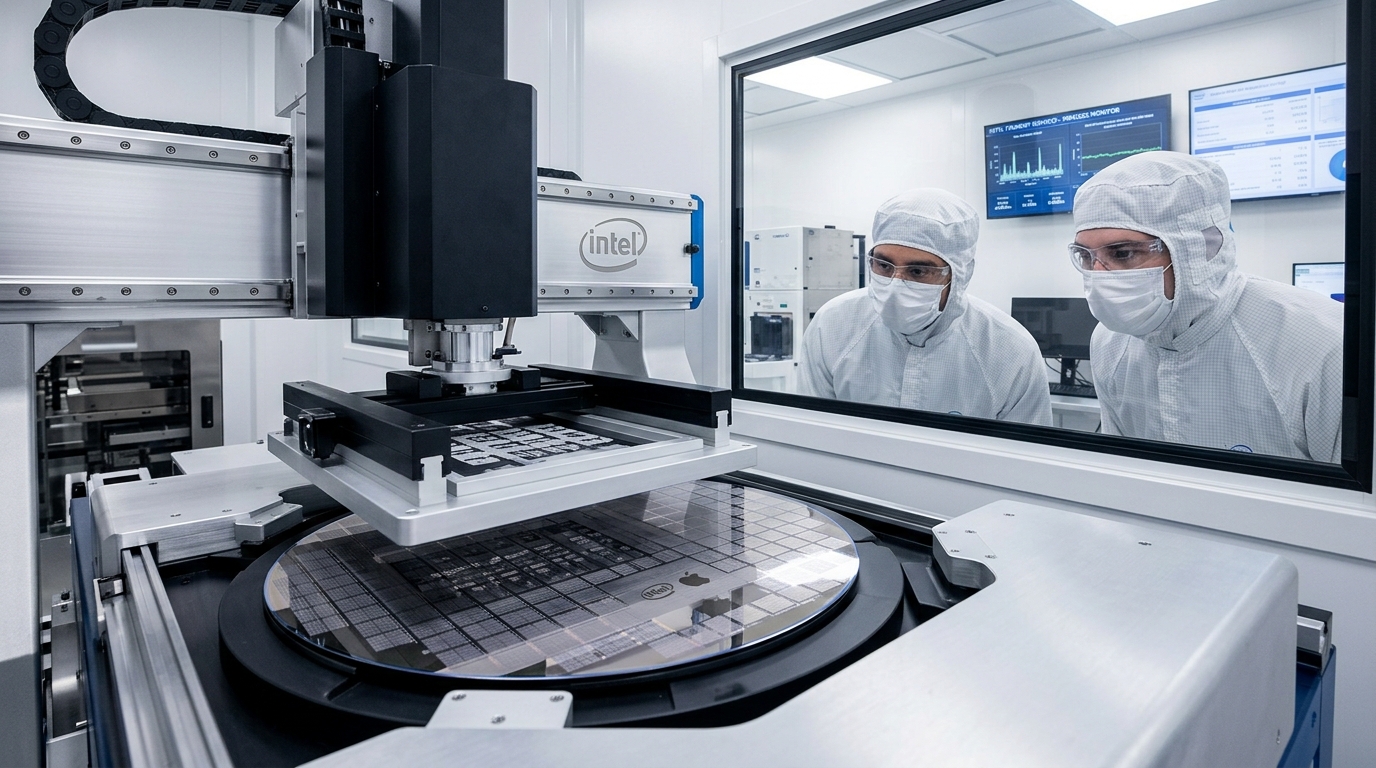
On June 18, President Trump announced on Truth Social that Apple has agreed to work with Intel to design and manufacture chips in the United States. Intel’s stock jumped more than 10% the same morning. Neither company confirmed the deal publicly, which is actually normal here. This one was in the works for months before it leaked.
But here’s where I want to slow down, because the Apple headline is almost a distraction from the deeper story.
What Actually Changed
Intel’s foundry business, the unit that manufactures chips for outside customers, has been burning cash for years. In Q1 2026 alone, that division reported $2.4 billion in operating losses. That’s real money, and it’s the single biggest reason skeptics have stayed away from this stock even as it tripled.
What changed is the customer list. A few months before the Apple announcement, Nvidia agreed to build early-stage chips with Intel. Elon Musk’s TeraFab project was announced as a major Intel foundry commitment. And now Apple, the world’s most demanding hardware customer, appears to be entering the picture as a foundry client for low-end M-series processors.
Think about what that does to Intel’s credibility. For two years, the company had essentially zero external foundry customers willing to go on record. Now it has three of the most visible names in the industry committing in a single quarter.
Supply chain analyst Ming-Chi Kuo suggests Intel could supply Apple’s lowest-end M chips starting as early as Q2 or Q3 2027. The initial volumes are expected to be small. TSMC isn’t losing its flagship iPhone business anytime soon. But the point isn’t the volume. It’s the validation. Intel’s 18A manufacturing node has been questioned by analysts for two years. Apple’s procurement team does not sign foundry deals out of charity.
The Numbers That Matter Right Now
- INTC stock: from a 2025 low near $17.67 to $133+ as of June 18, 2026
- Data Center and AI revenue: up 22% year-over-year in Q1 2026, first double-digit result since 2022
- Foundry pipeline: reportedly exceeding $15 billion in lifetime commitments
- U.S. government stake: $8.9 billion investment, roughly 10% of the company
- Forward P/E: stretched well above 90x on consensus 2026 numbers, which prices in near-perfect execution
That last point is where it gets complicated.
The Valuation Problem Nobody Wants to Say Out Loud
Intel is not cheap. Free cash flow is still negative through 2026 on most consensus estimates. The foundry division won’t break even until 2028 at the earliest, according to most analyst models. The stock has already moved so far, so fast, that it’s now pricing in scenarios that require gross margins to recover to roughly 48% by late 2027. That’s plausible. It is not guaranteed.
Slight tangent, but it matters: Apple dropped Intel entirely in 2020 because Intel couldn’t deliver on its node roadmap. Every investor old enough to remember that transition carries some skepticism about Intel’s ability to execute at volume. That skepticism is rational. The difference now is that CEO Lip-Bu Tan has a track record, the government has financial skin in the game, and TSMC’s capacity is being squeezed by AI demand from Nvidia and AMD. Intel is the only credible U.S.-based alternative at advanced nodes. That geopolitical moat is real, even if the financial moat is still being built.
Who Benefits. Who Is at Risk.
Bulls: If 18A achieves competitive yields and Apple expands from entry-level M chips to higher-volume products over time, the re-rating from turnaround story to foundry platform could be substantial. One analyst model puts a bull case near $120, with stretch targets above that.
Bears: The stock has already moved 360% in 12 months. Execution risk on 18A yields remains real and unproven at volume. A single bad quarter, especially if foundry losses don’t narrow as expected, could send the stock back to the low $90s fast. The valuation leaves almost no margin for error.
TSMC (TSM): Technically competition, but analysts are clear. The Apple deal starts with Intel’s lowest-end, smallest-volume products. TSMC’s share of Apple’s flagship chips is not threatened in any meaningful near-term window.
The Time Horizon Question
The Apple deal won’t generate material revenue for Intel until 2027 at the earliest. The foundry losses narrow slowly. This is not a trade for the next 30 days. It’s a thesis for the next 18 to 36 months, and the stock already reflects a lot of that optimism.
For investors who missed the 360% run: this is not the same risk/reward it was at $47. For those already holding: the catalysts are real, but the stock needs execution to stay ahead of its own hype.
What I keep coming back to is this. Apple’s decision to diversify away from TSMC isn’t just about Intel. It’s about what happens to chip supply when AI keeps absorbing more and more of TSMC’s advanced capacity. That constraint doesn’t go away. And Intel is the only Western foundry that can even attempt to fill the gap.