Most utility investors focus on the dividend yield. Fewer ask the harder question: where is the cash actually coming from, and can the company keep spending at this pace without eventually cutting the payout? RWE’s nine-month results, published this morning, offer a rare chance to work through that question with real numbers.
What the Numbers Show
Adjusted EBITDA rose 35% to €4.6 billion in the first nine months of 2026, while adjusted earnings per share climbed 42% to €2.52. That already puts the company at around 85% of its full-year adjusted earnings per share target after just nine months. RWE reaffirmed its full-year 2026 adjusted EBITDA forecast of €5.75 billion to €6.35 billion, with results expected towards the upper end of the guidance range.
The increase was driven by contributions from newly commissioned assets, more favourable wind conditions in Europe, and improved results from Supply and Trading. The Offshore Wind business alone generated adjusted EBITDA of €1.11 billion in the first nine months, compared with €915 million in the same period of 2025.
The Dividend Question
RWE reaffirmed its dividend target of €1.32 per share for 2026, with annual increases of 10% expected through to 2031. That is the promise. Now check the funding.
The company invested €10.7 billion net during the first nine months and reported net debt of €17.0 billion at September 30, 2026. Spending at that rate while targeting a rising dividend is exactly the kind of combination that deserves scrutiny. The key is whether earnings growth is outpacing capital deployment fast enough to keep the payout ratio comfortable. RWE confirmed its 2026 earnings guidance, forecasting adjusted net income of between €1.95 billion and €2.45 billion. Against a €1.32 dividend on roughly 670 million shares, that implies a payout ratio well inside 50% of adjusted net income at the guidance midpoint. The buffer is real, not cosmetic.
RWE expects net investment to fall to approximately €12 billion by year-end, mainly due to the deconsolidation of the two Vanguard projects following the establishment of the joint venture with KKR. That deconsolidation is the structural point income investors should notice.
What the KKR Deal Actually Does
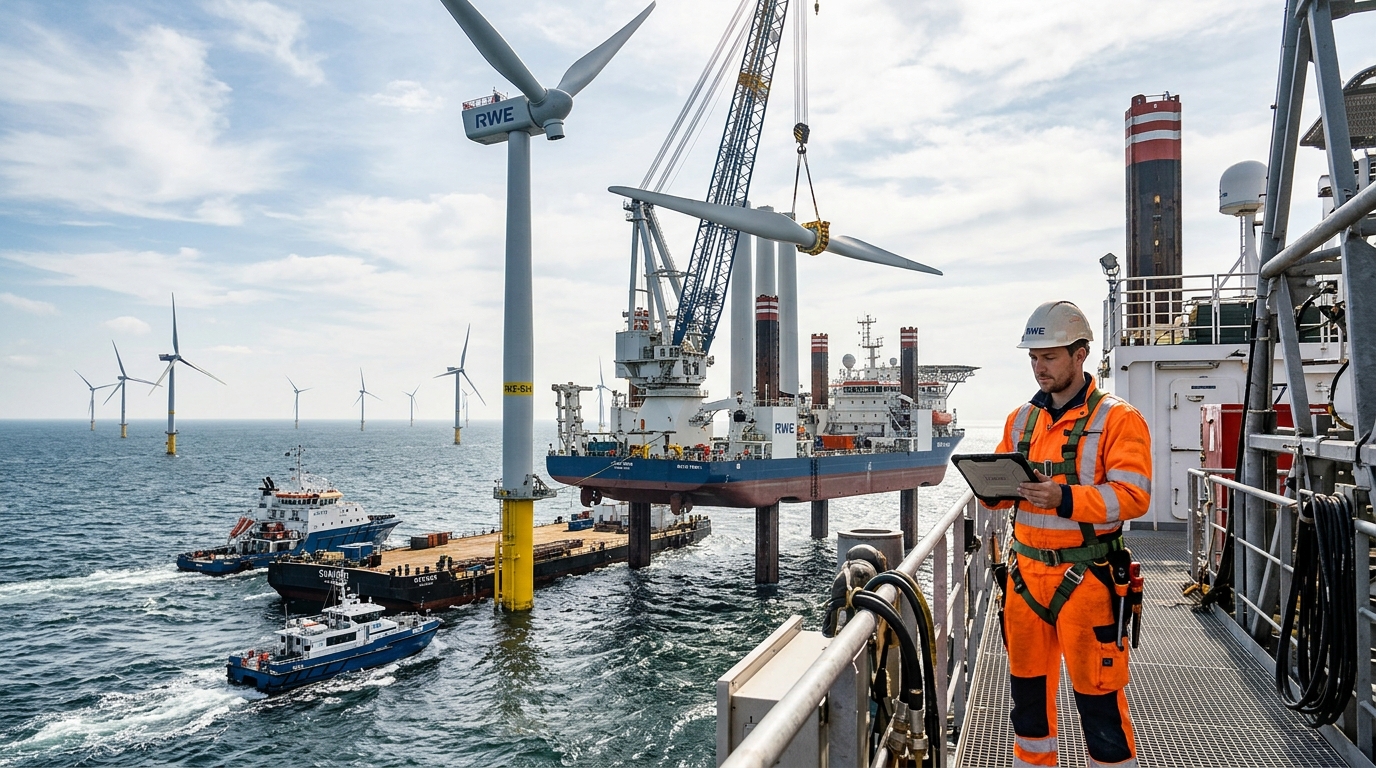
RWE and KKR reached financial close on the 2.8 GW Vanguard West and Vanguard East offshore wind projects in the UK North Sea, with KKR acquiring a 50% equity stake in each project. RWE leads construction and operations.
The developments secured £11.1 billion in cash facilities and £1.7 billion in ancillary facilities through non-recourse project financing from a consortium of 35 international banks, described by the companies as the largest financing of its kind for UK offshore wind. Non-recourse is the operative word: those liabilities sit at the project level, not on RWE’s balance sheet. Offshore construction is scheduled to begin in early 2027, with both projects expected to be fully commissioned in 2030. In January 2026, each project was awarded a 20-year inflation-indexed Contract for Difference at £91.20 per megawatt-hour in 2024 prices.
The Wealth-Building Lesson
Bringing in KKR as a 50:50 partner recycles capital that would otherwise sit tied up in construction for four years. RWE keeps operating control, retains half the long-term cash flow from inflation-linked contracts, and reduces the gross balance-sheet burden. That is not financial engineering; it is a repeatable model for funding a growth pipeline without sacrificing the dividend.
Income investors evaluating any utility should run the same three checks RWE’s results illustrate today: Is the payout ratio covered by adjusted earnings, not just reported earnings? Are large capital commitments structured to limit balance-sheet exposure? And does the revenue backing future cash flows carry inflation protection? When all three answers are yes, the dividend is a function of financial architecture, not just management goodwill.
RWE’s nine months pass that test. The harder question is whether the full year, and 2027 beyond it, hold the same shape.