Ford Motor has spent roughly $19.5 billion writing down losses on electric vehicles. Now it wants credit for turning those same factories into something the grid actually needs. The question investors should be asking on September 6, 2026 is not whether the energy storage idea is smart. It is whether the timeline holds and what the business is worth before it turns a single dollar of profit.
The Bet in Plain Terms
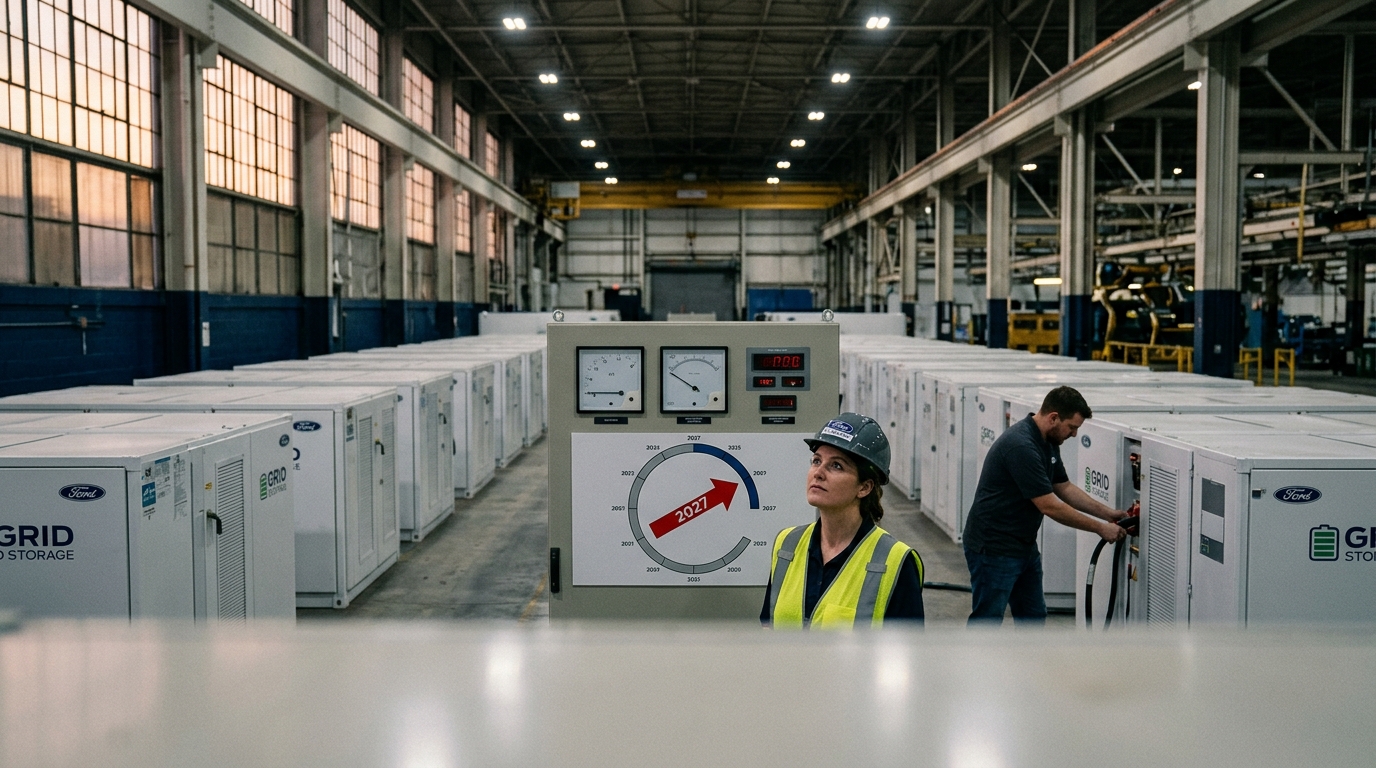
Ford Energy sits inside the Model e electric vehicle segment, which has guided for $4.0 billion to $4.5 billion in losses in 2026 before reaching breakeven by 2029. The key turning point is expected to be the ESS business coming online in late 2027. The battery storage systems will come from one of two battery plants at the BlueOval SK Battery Park in Glendale, Kentucky, that Ford is taking full ownership of following the dissolution of its joint venture with SK On. Ford expects to deploy at least 20 gigawatt-hours annually from that facility by late 2027.
Ford Energy has already signed its first customer: EDF power solutions North America, a subsidiary of France’s EDF Group, which will have the ability to procure up to 4 gigawatt-hours of battery energy storage systems annually under a five-year framework agreement, representing up to 20 GWh total volume over the term. That is one anchor deal for a business that needs to fill 20 GWh of capacity to make the math work.
Why This Matters Now
The backdrop makes the pivot legible. August new-vehicle retail sales are on track for a 6.9% decrease year over year. EV share has softened following the elimination of federal EV credits. Ford’s core vehicle business is contracting at the exact moment it is asking investors to underwrite a new industrial enterprise.
The grid storage market is expanding fast enough to absorb Ford’s ambitions if execution holds. The U.S. Energy Information Administration expects about 24 gigawatts of new utility-scale battery storage to be added in 2026, versus a record 15 GW added in 2025. Ford Energy is entering a market where Tesla is a major player. Tesla deployed 46.7 GWh of energy storage in 2025. Ford’s 20 GWh target is meaningful but still less than half of what Tesla is running.
What Wall Street Is Pricing In
Morgan Stanley analyst Andrew Percoco says Ford’s energy storage business is an underappreciated competitive advantage worth up to $10 billion. Ford Energy’s licensing deal with CATL positions it as one of the few semi-vertically integrated domestic battery energy storage suppliers in the U.S. The business could generate $500 million to $600 million in annual earnings before interest and taxes at full production capacity.
Morgan Stanley’s bull case assigns a higher multiple to Ford Energy than to the company’s automotive operations, estimating $2 per share of equity value for Ford Energy on top of $13 per share for the core auto business. CEO Jim Farley told investors on the second-quarter earnings call in July that Ford is in the “third inning” of selling out the 20 gigawatt-hours of 2028 production capacity for ESS after announcing the five-year framework agreement with EDF power solutions North America.
The Bull Case
Ford holds two structural advantages that pure-play storage companies cannot replicate: a century of high-rate manufacturing discipline and domestic cell production at scale. A CATL licensing deal positions Ford as a potential U.S.-assembled energy storage supplier supported by favorable tax credits. Utilities and data center operators hunting for non-Chinese, domestically sourced BESS supply are Ford’s natural customer base. Morgan Stanley expects Ford to announce supply agreements with large commercial customers, and possibly hyperscalers, within the next few months.
The Bear Case
Ford Energy has no revenue yet and first availability is planned for late 2027. Achieving the 20 GWh target will require flawless coordination across cell manufacturing, module assembly, logistics, and an after-sales service capability still being built out at scale. The late-2027 first delivery timeline leaves roughly 18 months to commission and prove an industrial operation of genuine complexity. Meanwhile, Model e lost $777 million in the first three months of 2026, and Ford expects losses will total between $4.0 billion and $4.5 billion for the whole year. Shareholders are funding that gap before Ford Energy ships a single container.
Competitors are not standing still. Tesla’s Megapack, Fluence, and GE Vernova all have established utility relationships and multi-year backlogs that Ford must break into cold.
What to Watch
Three things will determine whether the thesis holds. First, additional customer announcements beyond EDF, particularly any hyperscaler deal, would validate both the product and the pricing power. Second, any capital expansion announcement at Kentucky or Marshall, Michigan would signal that the 20 GWh target is a floor rather than a ceiling. Third, the Q3 Model e loss figure, due in late October, will show whether the structural cost reductions are tracking ahead of the 2029 breakeven target or slipping.
Bottom Line
Ford’s grid-storage pivot is a credible industrial idea funded by an automotive balance sheet under pressure. Morgan Stanley analyst Andrew Percoco has called Ford Energy an underappreciated driver of a path to profitability for Ford’s Model e electric vehicle business. At a potential $10 billion standalone valuation against a company trading well below its book value on auto multiples, the optionality is real. But every month of delay before late-2027 first deliveries is another quarter of nine-figure losses with no offset. Investors who believe in the storage market and Ford’s manufacturing legacy have a position worth building. Those who need proof before paying should wait for the first contracted deliveries to land.