
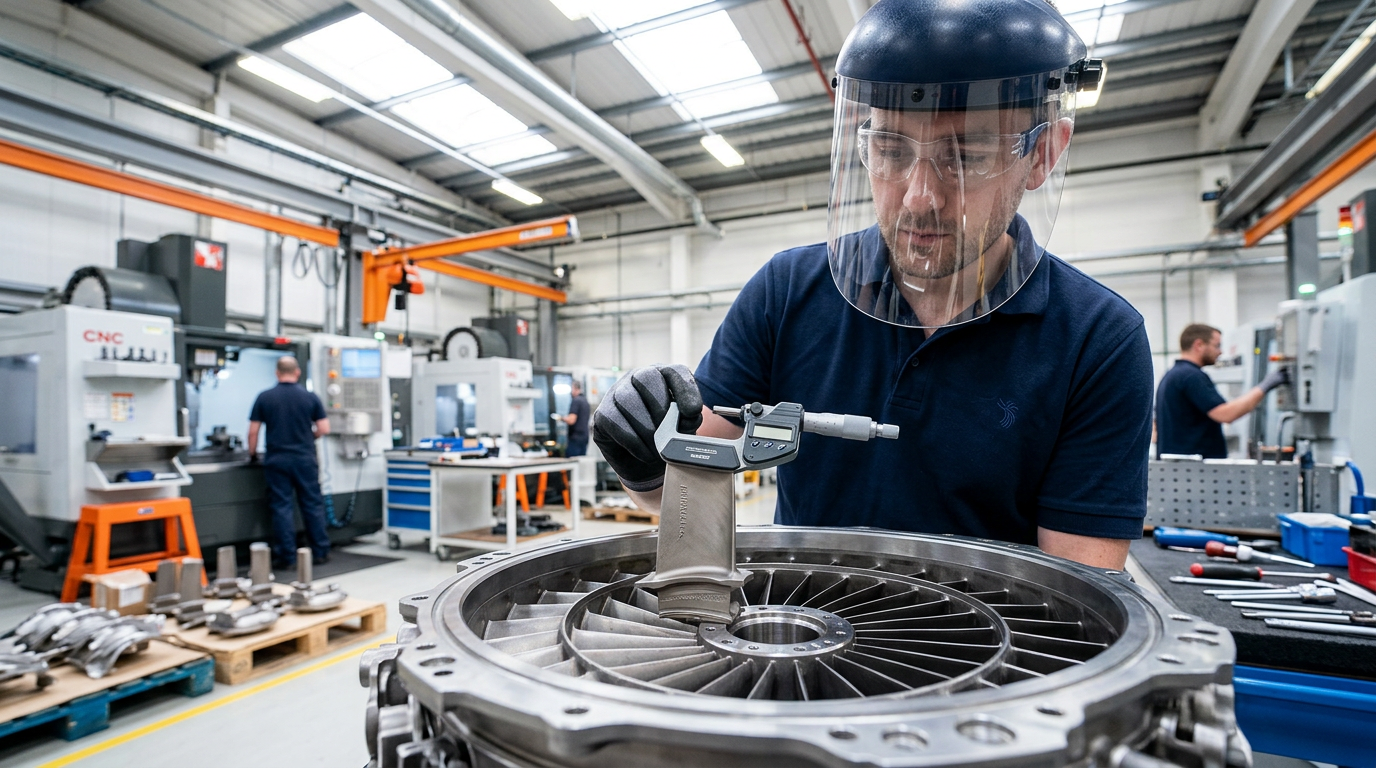
Most investors think about the aerospace supercycle through the lens of Boeing or the defense primes. That’s the obvious trade. The less obvious one – the one that has quietly outperformed nearly every name in the sector – is sitting in the engine components business.
Howmet Aerospace.
It’s not a household name. Most retail investors couldn’t describe what it makes. But the numbers are hard to argue with.
What the Business Actually Does
Howmet (NYSE: HWM) makes the parts that go inside jet engines, airframe structures, and fastening systems. These are not commodity components. These are precision-engineered, mission-critical pieces that aircraft manufacturers depend on to meet certification standards and production ramp targets. The barriers to entry are almost absurdly high. Certification alone takes years. And once you’re qualified on an engine program, you tend to stay qualified.
That’s the part people keep underestimating about this business. It is not just an aerospace supplier. It is a toll booth inside the aerospace supply chain.
The Numbers Are Compounding Fast
In Q1 2026, Howmet reported revenue of $2.31 billion, up 19% year over year. Adjusted EPS came in at $1.22, up 42% from the prior year. Adjusted EBITDA hit $740 million, up 32% year over year, with margin expanding 320 basis points to 32%.
Free cash flow for the quarter was $359 million – after $94 million in capex – and the company used $300 million of that to buy back shares.
Slight tangent, but it matters: a company printing 32% EBITDA margins in a manufacturing business is genuinely unusual. That’s closer to software economics than what most people associate with aerospace suppliers. It tells you something real about the pricing power Howmet has built over decades of being embedded in engine programs.
The three growth drivers in Q1 were commercial aerospace up 20%, defense aerospace up 10%, and gas turbines up 39%. That last number is worth sitting with. Gas turbines – used to generate power for data centers, among other applications – grew nearly 40% in a single quarter. That is not an accident.
The Guidance Tells You More Than the Quarter
After the Q1 beat, management raised its full-year 2026 revenue guidance to approximately $9.65 billion.
Jefferies raised its price target to $340. JPMorgan moved to $310 with an Overweight rating. The analyst community is not fighting this stock. They are chasing it upward.
And then there’s the acquisition layer. On April 6, 2026, Howmet completed the purchase of Consolidated Aerospace Manufacturing (CAM) from Stanley Black & Decker for approximately $1.8 billion in cash. CAM expands Howmet’s position in fasteners – a segment that most people ignore but that generates significant recurring revenue every time a commercial jet goes in for maintenance or modification. That deal hasn’t been fully digested yet by Wall Street models, which means the organic growth story may still be understated.
Why This Matters Right Now
Commercial aerospace OEM customers are targeting production rate increases supported by what Howmet management described as record backlogs. Engine spares demand – the aftermarket business – continues to grow as the global fleet ages and travels more. Defense is accelerating. And the gas turbine business is benefiting from a structural demand shift tied to data center power requirements.
All three of those trends are getting bigger in 2026, not smaller.
The stock is up roughly 51% over the past 52 weeks. The 52-week range runs from approximately $169 to a high of around $291.
Q2 2026 results are scheduled for August 6. The company’s own guidance for Q2 was set at $1.22 to $1.24. That pattern of guiding above Street and then beating again is worth watching.
The Risks Are Real
The valuation is not cheap. HWM trades at a premium multiple relative to traditional industrials. That premium is earned by the margin profile and the growth rate, but it also means there’s limited room for execution misses.
Production delays at Boeing or Airbus could create near-term demand headwinds for engine components. Any softening in airline travel or defense budget compression would flow through. And the $1.8 billion CAM acquisition adds integration risk that hasn’t fully shown up in the numbers yet.
The gas turbine story is compelling, but it assumes continued AI infrastructure spending – a thesis that has been tested and debated repeatedly through 2026 amid the chip sector’s own volatility.
The Bigger Picture
What’s interesting about Howmet is that it sits at the intersection of three converging macro themes: an aerospace supercycle driven by record airline backlogs, a defense spending ramp that is accelerating globally, and the AI power buildout that is creating new industrial demand for gas turbines.
Most stocks get one tailwind. Howmet is getting three at the same time, and the operational leverage is showing up in the margin structure.
August 6 is when the next data point lands. Between now and then, the question for investors watching this stock is whether the Q2 beat-and-raise pattern holds – and whether the gas turbine segment can sustain the growth rate it posted in Q1.
That’s the number worth watching. Not the headline EPS. The gas turbine line.
Disclaimer: This editorial is for informational purposes only and does not constitute investment advice, a recommendation, or a solicitation to buy or sell any security. The information presented reflects publicly available data as of July 18, 2026. Past performance is not indicative of future results. Investing involves risk, including the possible loss of principal. Always conduct your own research and consult a qualified financial advisor before making any investment decisions.