Something shifted this week. Not on earnings, not on guidance — but in the direction Jensen Huang is pointing.
After a whirlwind Computex keynote in Taipei and a headline-grabbing trip to Seoul, Nvidia’s CEO has made one thing unmistakably clear: the company isn’t just building the infrastructure for AI. It’s building the operating system for a physical world that runs on robots.
The Setup Right Now
NVDA is trading around $218.66 — a level that, by GuruFocus’s GF Value measure, sits roughly 35% below intrinsic value at $337.26. The P/E multiple has compressed dramatically versus its five-year median. And yet the narrative is anything but bearish.
Huang described AI demand as parabolic on Nvidia’s most recent earnings call — a word he doesn’t use lightly. Fiscal Q1 FY2027 revenue hit $81.6 billion, up 85% year over year, smashing Wall Street’s $78.9 billion estimate. Data center revenue alone climbed 92% to $75.2 billion. Non-GAAP EPS rose 140% YoY to $1.87. That’s not a company slowing down.
The Robotics Pivot Is the Real Story
Huang landed in Seoul on June 5 calling robotics South Korea’s “next major sector” — and immediately scheduled meetings with Hyundai, Samsung, LG, SK, and Naver. That’s not a PR tour. That’s a supply chain embedded strategy.
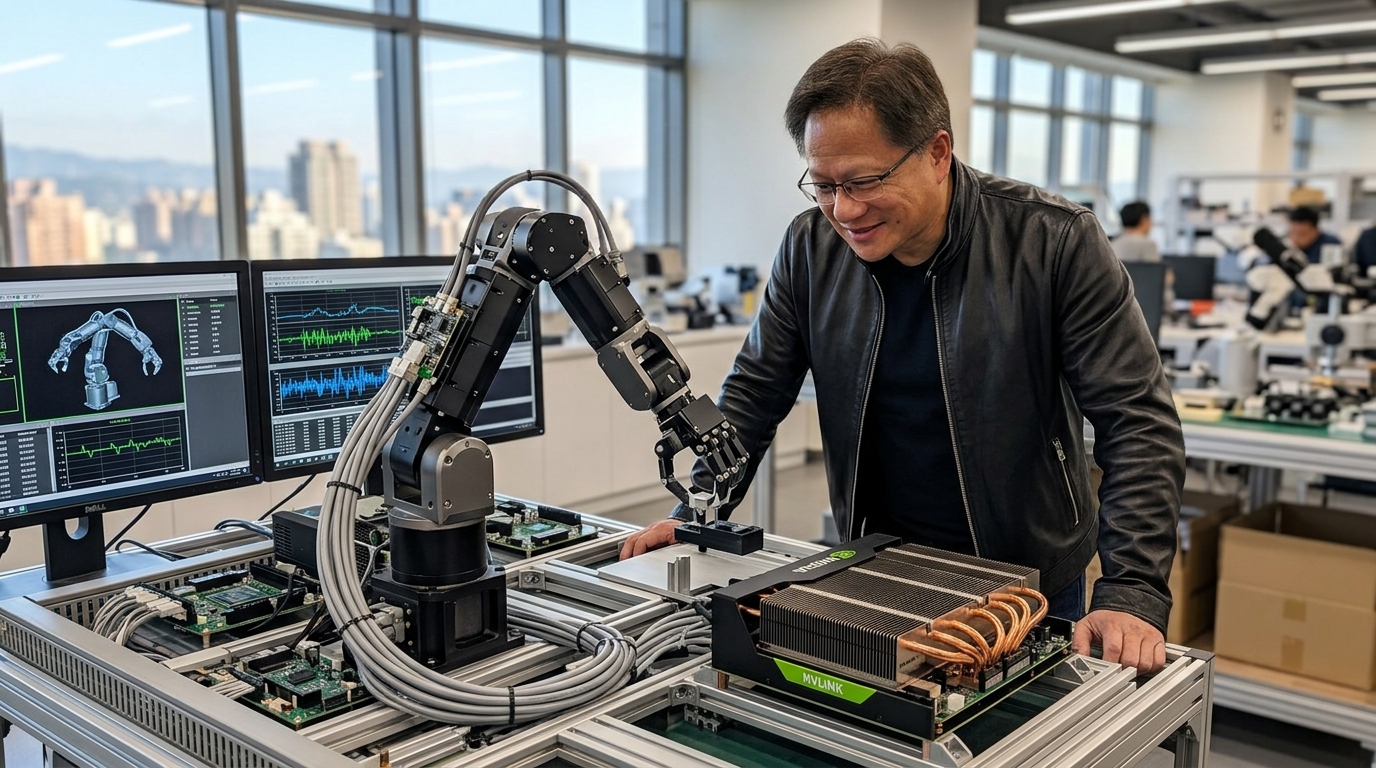
Slight tangent, but it matters: Nvidia isn’t positioning robotics as a side bet. Huang has publicly floated a $40 trillion addressable market figure for humanoid robots and autonomous systems. The Isaac GR00T humanoid foundation model, the Cosmos world simulation platform, and the DRIVE Hyperion partnerships across Hyundai, Uber, BYD, and others — these aren’t prototypes. They’re deployment infrastructure.
At Computex, Nvidia also announced the N1X processor — part of a new RTX Spark superchip for Windows PCs — targeting the agentic AI edge compute market. Microsoft and Dell are among the partners launching Nvidia-powered PCs this fall. That puts Nvidia in direct competition with Intel and AMD on their home turf.
What’s Actually Being Repriced
- Agentic AI acceleration: Systems that reason and act autonomously — not just respond to prompts — are driving a new wave of compute demand that Huang says is fundamentally different from the LLM training cycle
- Physical AI expansion: Nvidia’s Cosmos platform trains robots in virtual environments before real-world deployment — a moat that compound with every deployment
- PC market re-entry: The N1X chip challenges x86 architecture dominance; if it lands, Nvidia opens a second multi-hundred-billion dollar market
- South Korea industrial integration: Partnerships with the world’s most robotics-dense manufacturing economy add a long-cycle revenue layer most models haven’t touched
The Risk That Keeps It Interesting
Nvidia’s biggest customers — Microsoft, Meta, Google — all have their own custom silicon programs. If that momentum builds, it creates a structural ceiling on data center share. Add insider selling ($385 million in shares sold over the last three months) and you have a stock where the bull case is enormous but the execution risk is real.
Whether you think NVDA at current levels is cheap or fairly priced depends entirely on how quickly physical AI graduates from thesis to revenue line. That answer is still being written.
For informational purposes only.