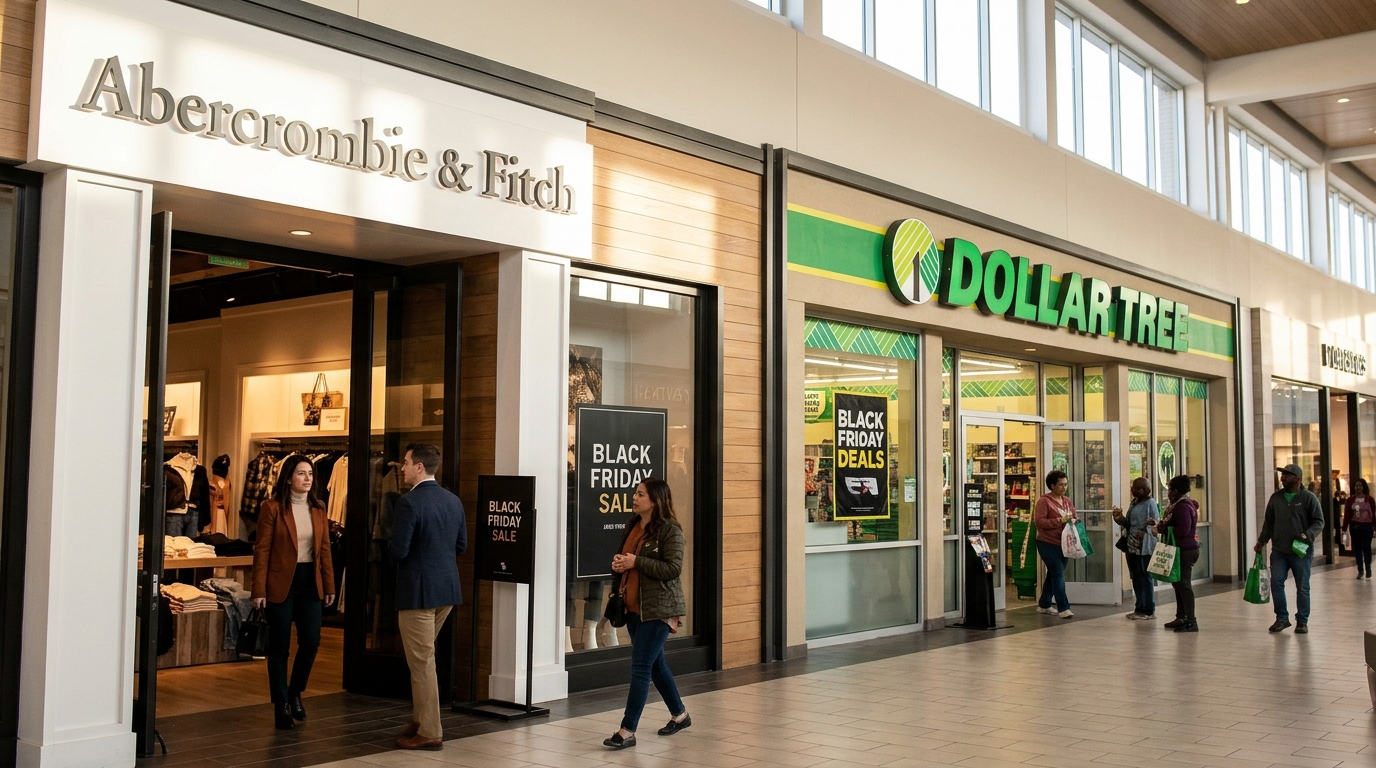
Two retailers reported record quarters Tuesday. Both stocks surged. The question now, with Black Friday 48 hours away, is which one actually deserves a new position after the move.
The honest answer is Dollar Tree.
Why This Stock Now
Dollar Tree rose about 11% on Tuesday after reporting better-than-expected third-quarter results and raising its annual profit guidance. Shares touched a 52-week high of $156.99, the highest level for the stock in more than three years. That is a meaningful breakout for a name that spent much of the year in recovery mode after the Family Dollar divestiture. The timing matters: Adobe, in its holiday-season forecast released September 28, projected $12.9 billion in U.S. online spending on Black Friday 2026 (November 27), up 9.2% from 2025.
Abercrombie had an even bigger day on paper. The company reported record third-quarter fiscal 2026 net sales of about $1.4 billion, up 11%, marking its 16th consecutive quarter of sales growth. The stock surged roughly 25% after results beat estimates. Impressive. But the combination of a substantial earnings beat, margin outperformance, and a confident guidance raise sent ANF to a new 52-week high of $172.80, well above its prior 52-week low of $69.68. You are buying a stock that already roughly doubled in a year and then added about 25% in a single session. That compression of future return matters.
The Dollar Tree Business
Dollar Tree reported record Q3 net sales of about $5.08 billion, up 6.9% year over year, and comparable sales growth of 4.6%. Traffic accelerated to 3.8%, while average ticket rose just 0.8%. That split is the signal worth watching. When traffic outpaces ticket, customers are choosing to show up more often, not simply spending more per trip because prices force it. Traffic increased 3.8%, a sharp improvement from 0.4% in the second quarter. One quarter of 0.4% traffic growth. The next: 3.8%.
Dollar Tree reported adjusted earnings per share of $1.16, far above Wall Street expectations. That gap is especially notable because management said results included about $0.42 per share in tariff refund reinvestment costs during the quarter, meaning the underlying result was stronger still. Management also said it was the sixth consecutive quarter the company has topped EPS expectations.
On the earnings call, management said multiprice reached 18% of sales, up about 300 basis points year over year. Mixed-price baskets represented about 25% of transactions and nearly half of sales, with basket sizes more than 2.5 times those of opening-price-point-only baskets. Management said multiprice remains in its early stages and is helping broaden the customer base and increase visit frequency. That is a runway, not a ceiling.
Why Wall Street Is Paying Attention
Management increased the fiscal 2026 adjusted EPS outlook to a range of $8.05 to $8.25. The company also said free cash flow more than doubled year over year to about $122 million, and that it repurchased 1.8 million shares for $205 million in the quarter.
The valuation case for DLTR is more straightforward than ANF’s right now. Several market data services put Dollar Tree’s trailing P/E around 17 to 19 times earnings. The bigger point still holds: even after the post-earnings jump, DLTR is not obviously priced as if the traffic acceleration and multiprice mix gains are already fully harvested. Compare that to Abercrombie, where the stock just posted a roughly 25% single-day surge into a new 52-week high.
Abercrombie’s Results Were Genuinely Good
None of this dismisses what Abercrombie accomplished. Comparable sales increased 6% overall, with APAC up 24%. Abercrombie brands grew comps 6% while Hollister grew 5%. Goldman Sachs raised its price target to $190, noting that both Abercrombie and Hollister recorded comparable-sales growth in the same quarter for the first time in almost two years. Management highlighted strong November sales momentum. Abercrombie raised its fiscal year 2026 EPS outlook to $13.70-$13.90 from $13.10-$13.60.
The problem is what comes attached to the price. Insider activity over the past year has skewed toward selling rather than buying. Meanwhile, Q4 EPS guidance of $4.40 to $4.60 came in below the analyst consensus tracked by major estimate services. When the biggest holiday weeks are still ahead and management already guided below the Street on earnings, a roughly 26% single-session move has priced in considerable optimism.
What Could Go Wrong
Dollar Tree is not without risk. Management said Q3 gross margin declined 10 basis points to 35.7%, with tariff reinvestments, product inflation, freight, and category mix pressuring profitability. If freight costs accelerate into 2027, the margin recovery could stall. The multiprice rollout also still needs to prove it converts foot traffic into sustained ticket growth rather than just more visits at the opening price point.
For Abercrombie, the risk is simpler: a 100%-plus run from the 52-week low, capped by a roughly 25% surge, leaves little room for a holiday-season miss without a painful reversal.
The Bottom Line
Both companies earned their moves Tuesday. But 48 hours before Black Friday, Dollar Tree offers something Abercrombie currently does not: a re-rating still in progress. The traffic acceleration from 0.4% to 3.8% in a single quarter, the multiprice momentum, and a roughly 25%-plus EPS beat heading into the highest-traffic shopping weekend of the year make DLTR the more compelling purchase today. Abercrombie can keep running. It simply needs everything to go right to justify buying the gap.