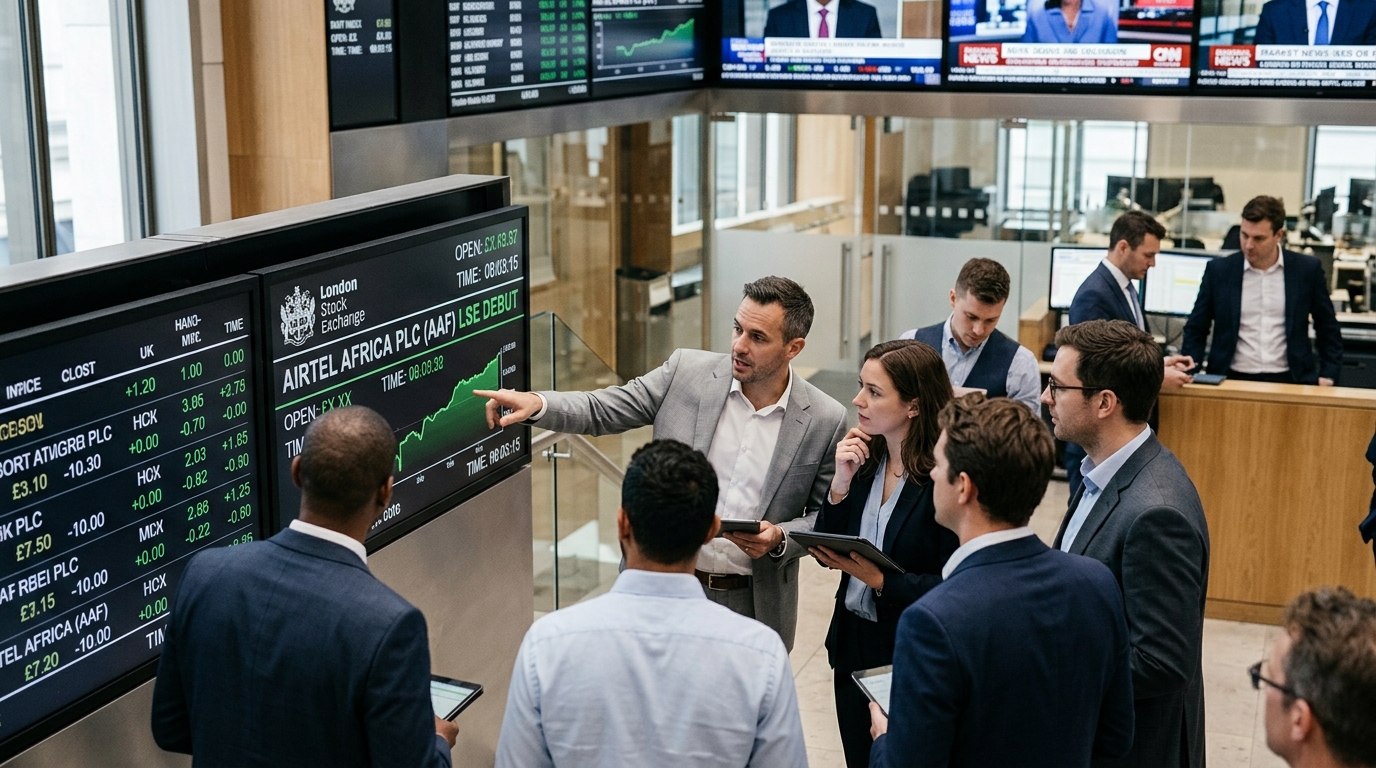
The date that matters is October 14. That is when Airtel Money, the mobile payments arm of Airtel Africa, begins unconditional trading on the London Stock Exchange’s Main Market at 8 a.m. London time. Even at a reduced size, it is set to be the London Stock Exchange’s biggest IPO in five years. For options traders, the right posture right now is watching, not buying.
What Just Got Priced
Airtel Money priced its London IPO at £1.96 ($2.59) per share, valuing the mobile money business at £5.3 billion ($7 billion) ahead of its October 14 debut, according to a regulatory announcement. This marks the first time the market will put a public price on Airtel Africa’s fastest-growing business, after years of turning mobile money into a major part of the group’s financial story.
The $7 billion valuation is below the $8 to $9 billion range reported when the IPO was announced, and most of the sale proceeds will go to existing investors rather than Airtel Africa or Airtel Money. That gap between early talk and final price is meaningful. It tells you that institutional demand, while sufficient to get the deal done, was not strong enough to hold the upper end of what bankers originally floated.
All the shares on offer are existing ones, meaning Airtel Money will not raise new capital from the listing. The proceeds will go to the selling shareholders, which include existing investors. The World Bank’s private-sector lending arm, the International Finance Corporation (IFC), committed to buy up to $90 million worth of shares as a cornerstone investor. Cornerstone support helped get the deal across the line; it does not guarantee a strong aftermarket.
The Business Behind the Float
As of June 2026, Airtel Money had 56.5 million customers, with annualised transactions of more than $245 billion. Total processed value has grown at a 33 percent CAGR to reach $213 billion, while revenue reached $1.346 billion for the year ended March 2026, with an EBITDA margin of about 50 percent. The underlying business is real and large. The question the options market will eventually price is whether the public float can sustain a valuation that early shareholders already found easier to exit than hold.
Airtel Africa will remain a strategic shareholder, and the IPO is expected to result in approximately 16.5% to 17.5% of Airtel Money’s shares being held in public hands, potentially qualifying it for FTSE UK index inclusion. A FTSE inclusion event would force passive buying and compress the free float further, which matters once a derivatives market eventually opens. It does not help you trade the first week.
Why Options Traders Sit Out the Launch
Airtel Money debuts with no listed options, no implied volatility history, and almost certainly no established borrow. That combination removes every defined-risk tool from the table. You cannot size a long call because there is no strike to buy. You cannot hedge with a put spread. You cannot fade an overreaction on day one with a short position if the borrow cost is prohibitive or simply unavailable.
What you can do is watch Airtel Africa (AAF.L), the parent that already trades in London. AAF.L closed recently around 306p, with a market cap near £11 billion and results scheduled October 30, 2026. That upcoming results date gives the parent stock its own catalyst within three weeks of the Airtel Money debut, compressing two separate events into a short window.
The Beast Verdict
Airtel Money’s October 14 listing is one of the most watched financial events in London this year, and the business itself scores well on fundamentals: about 50 percent EBITDA margins and more than $245 billion in annualised transaction volume. The problem for options traders is structural, not fundamental. No options chain exists. No borrow is established. The free float of roughly 16 to 17 percent is thin, which means early price swings could be sharp and driven by technical factors rather than any change in the underlying business.
For Safaricom and other African fintech competitors, Airtel Money’s October price will be the number every board paper quotes. For options traders, the October 14 open is a reference point to log, not a trigger to act on. The opportunity here comes later, once implied volatility settles, a borrow market forms, and the stock shows how it trades around the parent’s results. Mark the debut. Build the thesis. The position comes after the dust clears.