
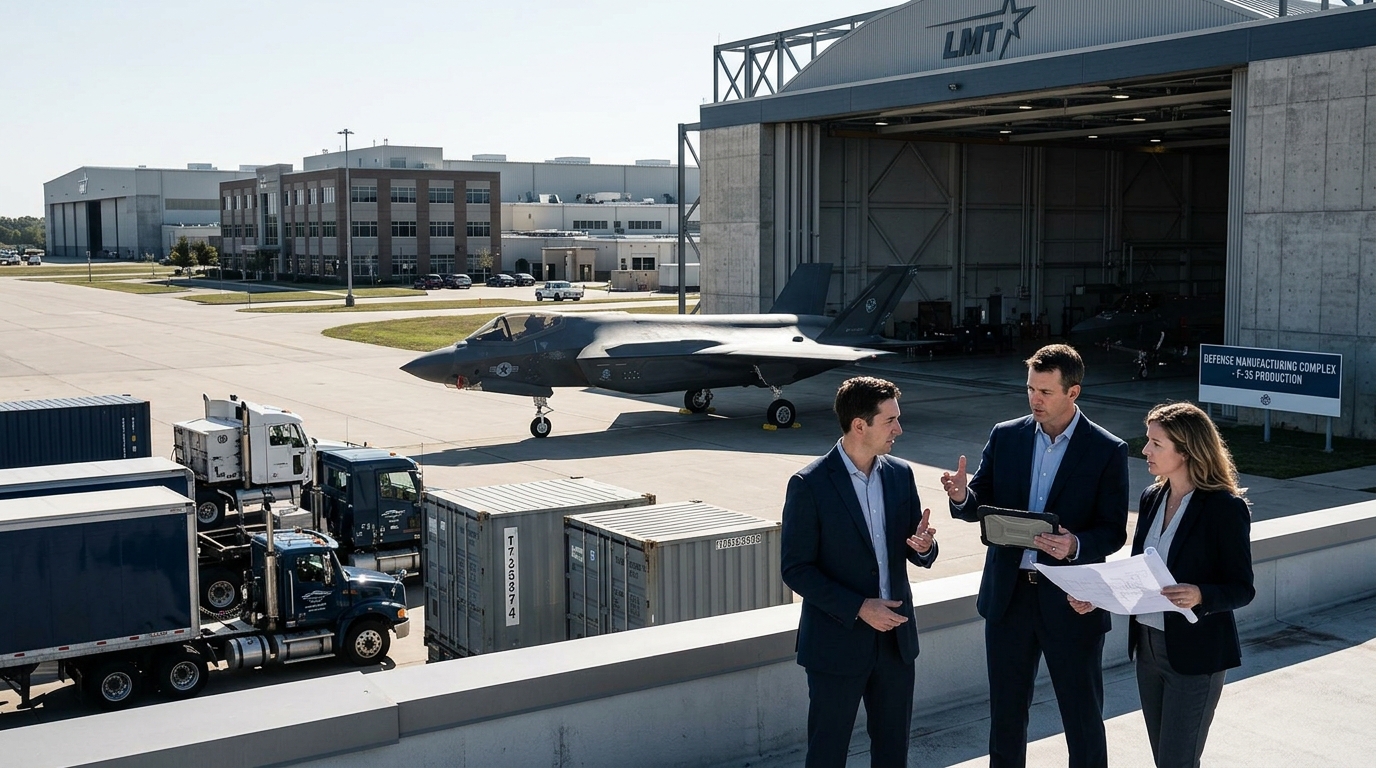
When everything in tech was selling off Thursday, Lockheed Martin went the other direction. The stock surged more than 10% on the session, closing at $568.59, on a day when the S&P 500 fell 1.2% and the Nasdaq dropped 2.2%. That kind of divergence is worth paying attention to.
The Q2 numbers were legitimately strong. Revenue of $20.1 billion, up 11% year over year, came in well ahead of the roughly $19.4 billion analyst consensus. EPS hit $7.94, beating the roughly $7.23 estimate. Free cash flow was $2.9 billion for the quarter, compared to negative $150 million in the same period a year earlier. The full-year sales outlook was raised to $79.75 billion to $81.75 billion, up from the prior $77.5 billion to $80 billion range. Free cash flow guidance for the full year was lifted to $7.0 billion to $7.2 billion.
The comparisons are a bit flattering because Q2 2025 was ugly. Lockheed absorbed $1.6 billion in program losses that quarter tied to a classified Aeronautics contract and two helicopter programs. Those losses did not repeat. Strip out that noise, and the underlying business still showed genuine improvement in volumes, margins, and order flow.
The Backlog Is the Number That Matters
LMT reported a record backlog of about $230 billion, up from $193.6 billion at year-end 2025. That is a staggering book-to-bill ratio of roughly 3.2 times revenue for the quarter, driven by $65 billion in new orders. The single largest driver was a $35 billion multi-year contract with the Missile Defense Agency for THAAD interceptors. The Missiles and Fire Control segment backlog rose to $87.9 billion as a result.
Put that in context. Lockheed Martin’s annual revenue runs roughly $80 billion. The backlog now represents about 2.9 years of sales. That is not a demand concern. That is a production constraint.
The segment breakdown tells the same directional story. Missiles and Fire Control sales jumped 19% to $4.1 billion, powered by higher PAC-3 and THAAD volumes along with the Precision Strike Missile program. Aeronautics grew 9% to $8.1 billion on stronger F-35 production. Rotary and Mission Systems grew 9% to $4.4 billion. Space grew 6% to $3.5 billion.
F-35 deliveries were 19 jets in the quarter, down from 50 a year earlier, which sounds concerning at first. That comparison is complicated by timing in prior-year deliveries and ongoing lot negotiations with the Pentagon. Management signaled that deliveries will reaccelerate in the back half. C-130J output rose to seven deliveries from just one in the prior year, which is a cleaner sequential signal.
The Contract Catalog Gets Bigger
Beyond the headline backlog, the contract activity around Lockheed right now is genuinely unusual in its breadth and duration.
A fresh 12-year U.S. Special Operations Command logistics deal carries a ceiling near $10.5 billion and extends a program Lockheed has run since 2010. The F-35 Joint Program Office also awarded Lockheed Martin a $1.6 billion contract for F-35 spare parts last week. The new PAC-3 ACE interceptor, built to plug into existing Patriot and IBCS systems, is positioned as a lower-cost option for global air defense demand at less than half the cost of the PAC-3 MSE. Lockheed Ventures is expanding to a $1 billion fund, opening a London office, and earmarking at least $100 million for UK and European defense-tech startups.
That last one is worth a moment. A defense prime opening a formal European venture arm is not a small signal. It reflects where the demand is going, and it reflects where Lockheed’s management thinks the next generation of defense technology will originate.
Where the Stock Stands
LMT closed at $568.59 on July 23, up about 10.5% on the session. The 52-week range runs from about $410 to $692. The all-time closing high was $672.30, reached on March 2, 2026. At current levels, the stock is roughly 15% off that high despite a fundamentally stronger backlog and higher guidance.
Analyst consensus sits around the low $600s, implying mid-single-digit upside from Thursday’s close. The split view is real and worth understanding. Wells Fargo cut its target from $650 to $575 at Equal Weight. TD Cowen trimmed from $600 to $560 at Hold. The broader Street remains overweight, with the average target in the low $600s.
Forward P/E of approximately 17 is not expensive for a business with a ~$230 billion backlog, 11% revenue growth, and free cash flow guidance above $7 billion for the year. LMT has raised its dividend for 23 consecutive years and just declared a Q3 dividend of $3.45 per share, payable September 25.
Three Scenarios From Here
Bull Case: F-35 delivery rate reaccelerates in Q3 and Q4 as lot negotiations close. Missiles and Fire Control sustains 15% to 20% growth on PAC-3 and THAAD production ramp. International demand from NATO rearming and Middle East allies drives new orders above $60 billion per quarter. Stock reclaims the $620 to $650 range into year-end as guidance is raised again.
Base Case: Full-year revenue lands at the high end of guidance near $81 billion. Segment margins stabilize in the 10% to 11% range. F-35 deliveries recover partially but remain below prior-year levels. Stock consolidates in the $540 to $590 range as analysts wait for clarity on F-35 lot pricing and the classified Aeronautics program status. Dividend growth continues.
Bear Case: Aftermarket and sustainment revenue softens in H2 as Wells Fargo flagged. F-35 delivery delays persist. Geopolitical de-escalation reduces urgency around new missile defense orders. The ~$230 billion backlog sits on the books but converts more slowly than expected, compressing margins. Stock tests the $480 to $510 range, which served as support in mid-June.
Active Trader Framework
The technical picture changed materially on Thursday. LMT had been grinding from the low $500s and broke decisively above the $545 to $560 resistance zone on heavy volume. The intraday range was wide, with the stock opening at $545.00 and pushing to $576.00 before settling at $568.59. That kind of range with a strong close suggests the breakout has institutional sponsorship behind it.
The 52-week low near $410 is a distant reference. Near-term support clusters around $535 to $545, the prior resistance zone that was just cleared. If the stock pulls back toward that level on light volume, it is a cleaner risk-defined entry for traders willing to position ahead of further contract announcements or Q3 guidance.
The geopolitical backdrop adds a variable that is hard to model precisely. Houthi attacks on Saudi tankers in the Red Sea, NATO rearming across Europe, and the ongoing Iran-U.S. tension in the broader Middle East all represent real demand signals, not hypothetical ones. Missile defense systems, air superiority platforms, and sustainment contracts are not discretionary in this environment.
One thing the market tends to underweight in defense stocks is the duration value of a backlog. When Lockheed books a $35 billion THAAD contract, that revenue does not show up next quarter. It shows up over years. The stock market wants to price that immediately. The income statement recognizes it gradually. That gap between immediate enthusiasm and slow accounting recognition is often where defense stocks get mispriced in the short run, in both directions.
The quarter was strong. The backlog is record. The demand environment is unlike anything this company has seen in at least a decade. The debate now is execution, margin recovery, and whether the F-35 program can stabilize its delivery cadence. Those are answerable questions. They are not existential ones.